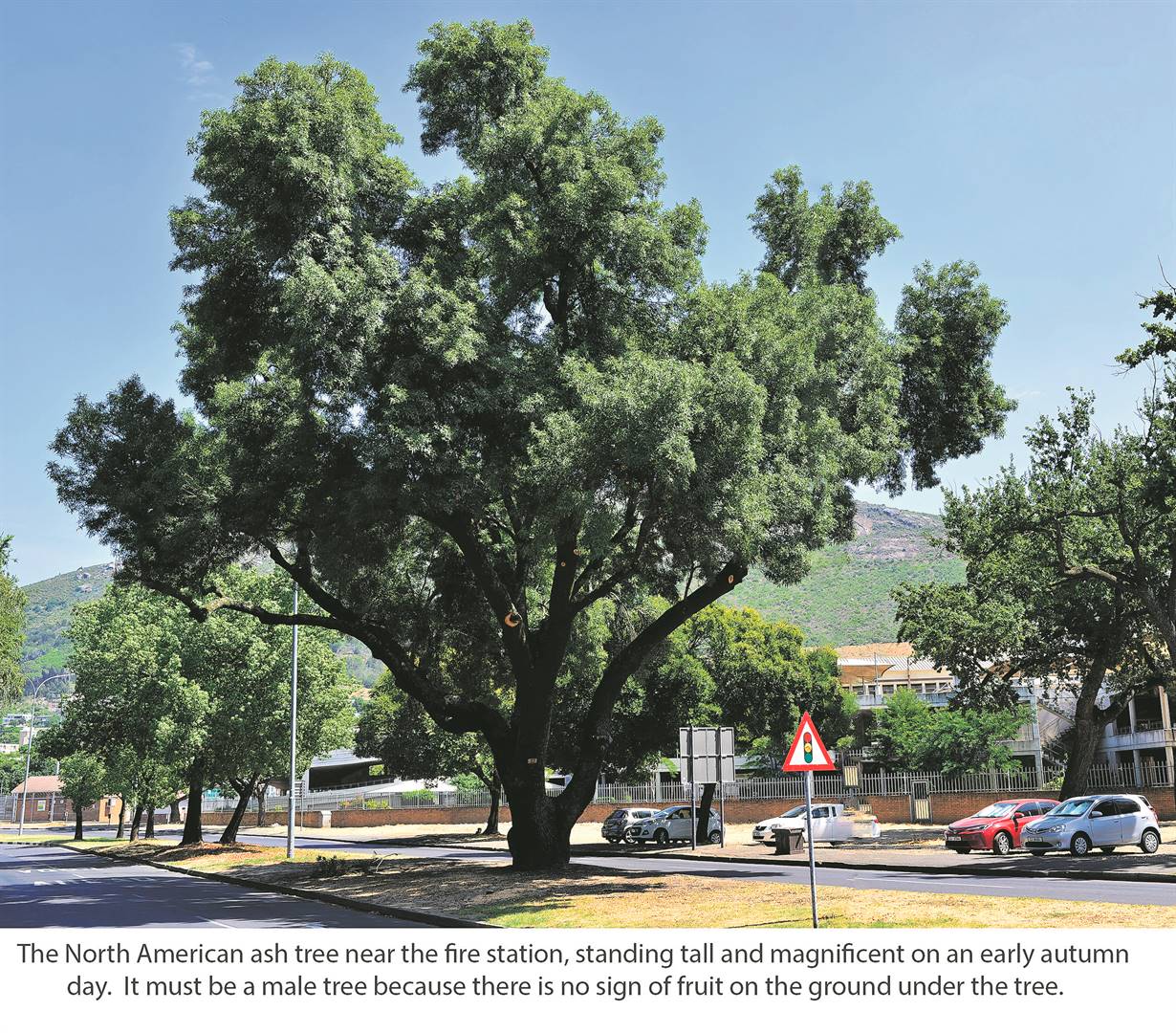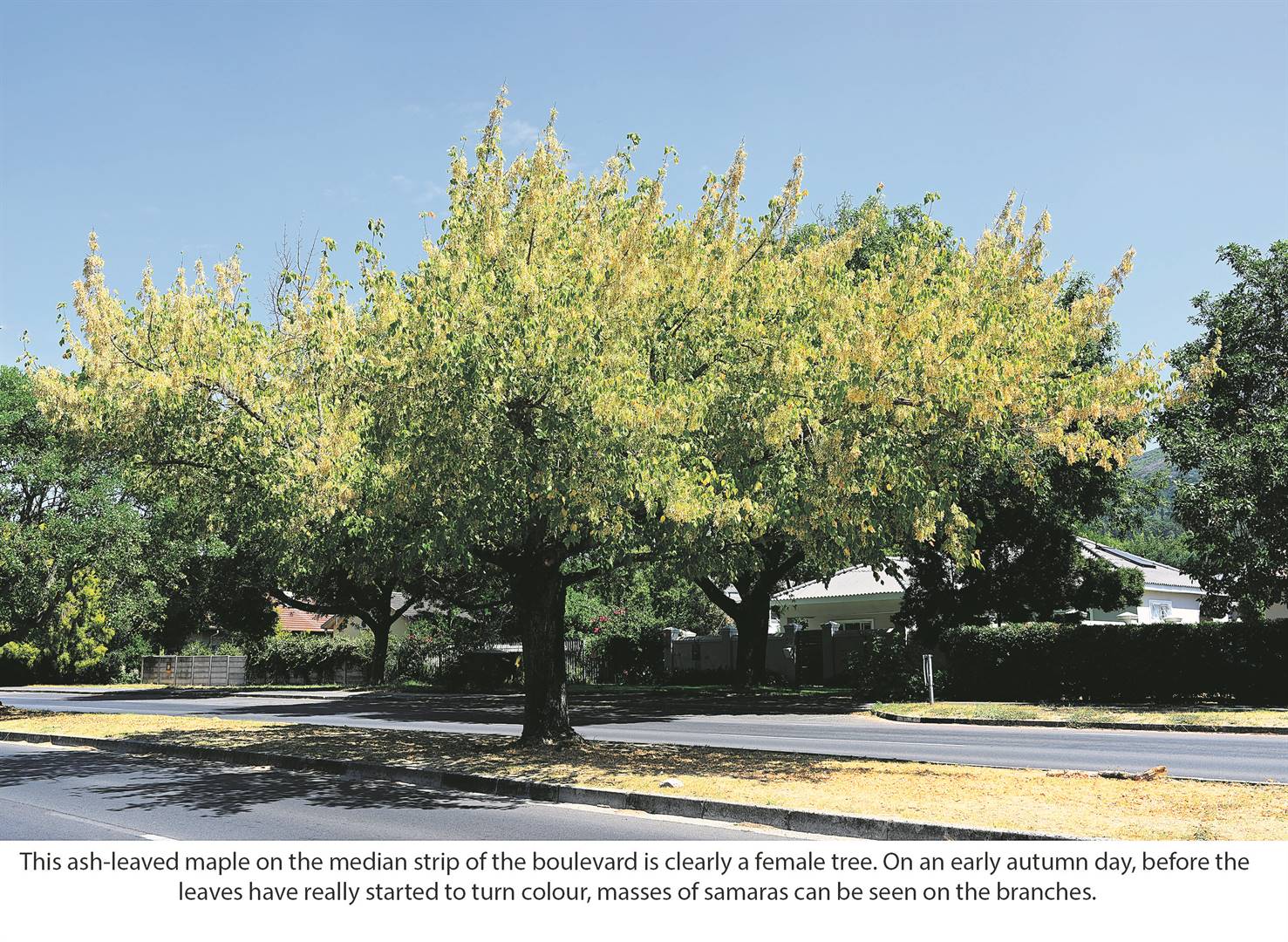
There are about 130 species of maples worldwide, almost without exception native to the northern hemisphere. Paarl has its fair share of them, mostly on pavements and road medians, a role for which they are eminently suitable. We look at the first two today, but we shall return to the maple genus (Acer) in future articles.
The ash-leaved maple is a small to medium-sized tree with compound leaves somewhat resembling the leaves of ash species. Most of the maples have simple leaves, sometimes quite big, but not compound, so the ash-leaved maple is one of the few exceptions. Another feature of the tree that differs from the norm for maples is that male and female flowers are borne strictly on separate trees. The fruit that develops from pollinated female flowers has the distinctive maple form known as a “double samara” – two winged nuts (“samaras”) joined at the base. The seed is dispersed by wind, for which purpose the wing is provided, as well as by flowing water. Seeds are usually prolific on female trees.
The native distribution area of the ash-leaved maple is the eastern USA, extending up into Canada. The tree is fast-growing and relatively short-lived, the typical lifespan being about 60 years. It provides attractive autumn foliage as the leaves turn yellow before dropping. Despite certain drawbacks, it is one of the most common maples in cultivation, and it has established itself in Europe, China and Australia. Sadly, it has proved to be a favourite prey of the shot hole borer, and its death after infestation one of the fastest. One year after the first signs of the scourge are noticed, an ash-leaved maple is dead.
In Paarl, ash-leaved maples are plentiful on the median strip of the Boulevard south of the fire station and in the adjoining residential areas.
The trident maple also produces its seed in the form of samaras, borne in brownish-coloured clusters in this case. Like the ash-leaved species, it is deciduous, but its leaves are simple, arranged in opposite pairs, and usually have three lobes, reminiscent of the trident, the three-pointed spear of Neptune in mythology. Its foliage is striking: spring growth emerges with a coppery red colour and matures to a glossy, dark green upper surface in summer. The autumn colours can vary, sometimes yellows but usually reds and oranges.
The trident maple originated in eastern China, Taiwan and Japan. Its preference is for full sun, and well-drained, slightly acidic soils, but it is tolerant of a range of soil textures and moisture levels. It is fairly slow-growing, but it becomes a medium-sized tree, providing valuable shade in summer. Its root system is not particularly vigorous, so many shade-loving plants can be grown beneath its canopy. It is a popular tree to use for bonzai work.