Starting their school careers as a Grade 1 learner can be daunting. The Western Cape Education Department shares some tips on how to tackle Grade 1 with confidence.
Preparing Grade R learners for Grade 1:
Grade R learners learn through play, play with a purpose.
It is important that parents and teachers are reminded that all children learn to master information differently. Therefore, Grade R learners receive multiple opportunities to try and try again.
School readiness happens throughout a young child’s life to better prepare him or her for Grade 1 and adulthood. That is why the first thousand days in a child’s life is so important.
The first 1 000 days refer to a child’s life from the moment they are conceived until they reach 2 years of age (24 months). This is a time when their brain, body and immune system grow and develop significantly.
The importance of Perceptual Development:
According to the Curriculum and Assessment Policy Statement (Caps), the development of perceptual skills in young children is extremely important for future developing and learning. Perception refers to the use of the child’s senses to gather information in the environment.
The development of perceptual skills takes place throughout the child’s learning, discovering, exploring, enquiring and inquiring. In the classroom the teacher has to focus on the development of perceptual skills across the three subjects: Home Language, Mathematics and Life Skills. Children learn skills through active engagement, using concrete apparatus and total physical involvement.
Simple actions such as crossing legs, crossing the midline, balancing, awareness of left and right, body awareness, catching, throwing and more are the kind of activities Grade R learners should do repetitively. The more they play these games, do, and describe their actions, the more confident, skilled and ready for Grade 1 they will become. These are ways for children’s communication skills, working together, critical thinking processes, problem solving, reasoning and thinking skills can be further developed.
Children’s reading, writing and mathematical skills can be strengthened by developing the child’s visual perception: obtaining and interpreting information through the eyes; accurate vision assists the child with important skills such as reading with meaning, understanding mathematics and neat and decipherable writing.
Visual discrimination: being able to notice similarities, differences and detail in objects.
Visual memory: having the ability to remember what you have seen and arranging in sequence through memory.
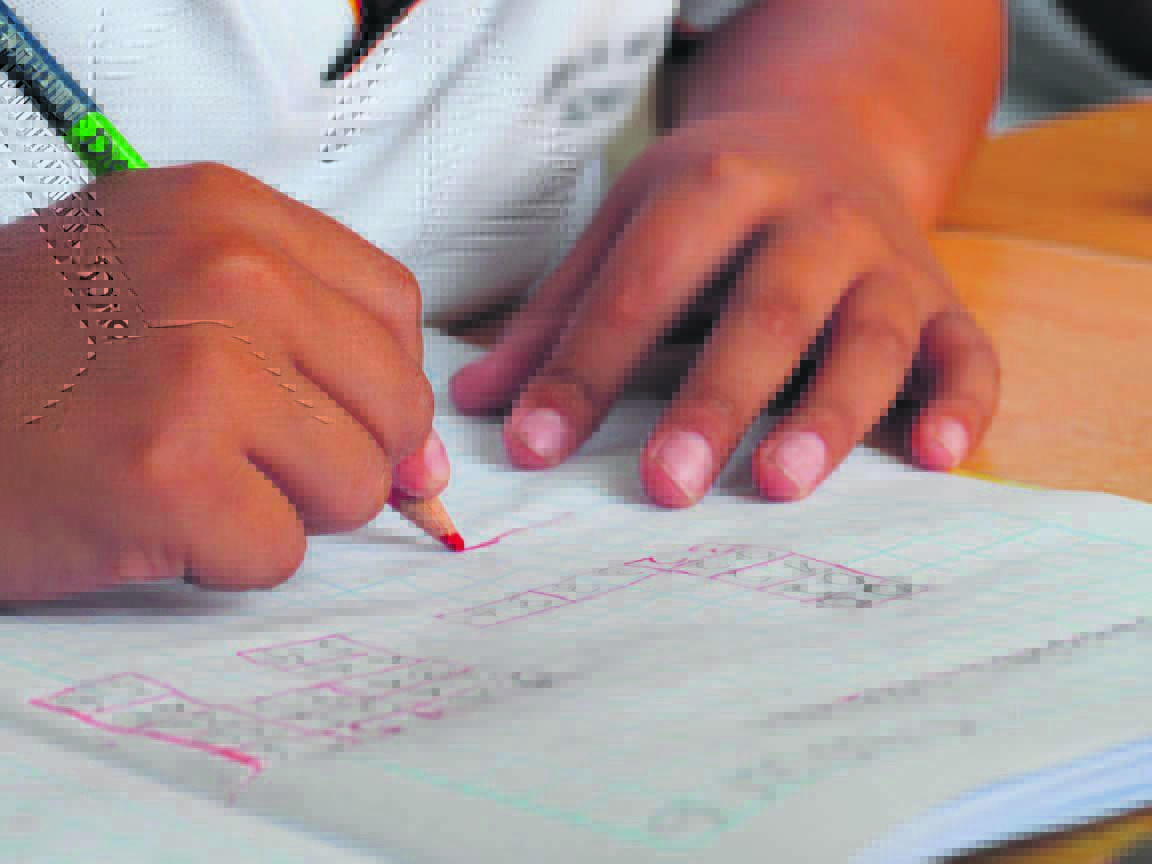
Visual motor coordination: eyes and hands work together almost with every action we do. Tying laces, pulling up your zip, buttoning your jacket, sorting buttons, threading beads, unlocking the door, choosing a sweet. Catching and throwing a ball, using scissors, packing toys away after they’re played with are good activities for young children to strengthen their visual motor coordination.
Gross motor development – balance, laterality, locomotion and more1. Stand-up exercise – stand up with eyes close and then open2. Balancing – walking on a line, string or bench3. Locomotion – jump, crawl, move forward or backwards, sideways, left and right4. Body awareness – feeling good about oneself, knowing one’s body parts5. Eye-foot coordination – kicking the ball, hopscotch
Fine motor development – eye-and-hand coordination
Activities which assist in fine motor development:
1. Building puzzles
2. Threading
3. Tearing and folding paper
4. Drawing and painting
5. Working with play dough
The WCED has Grade R interactive posters available for parents and teachers. These activities can assist with Home Language, Mathematics and Life Skills by further developing skills needed for school readiness and beyond.
This information is readily available on the WCED eportal. Parents can visit the following link to access the information – https://wcedeportal.co.za/