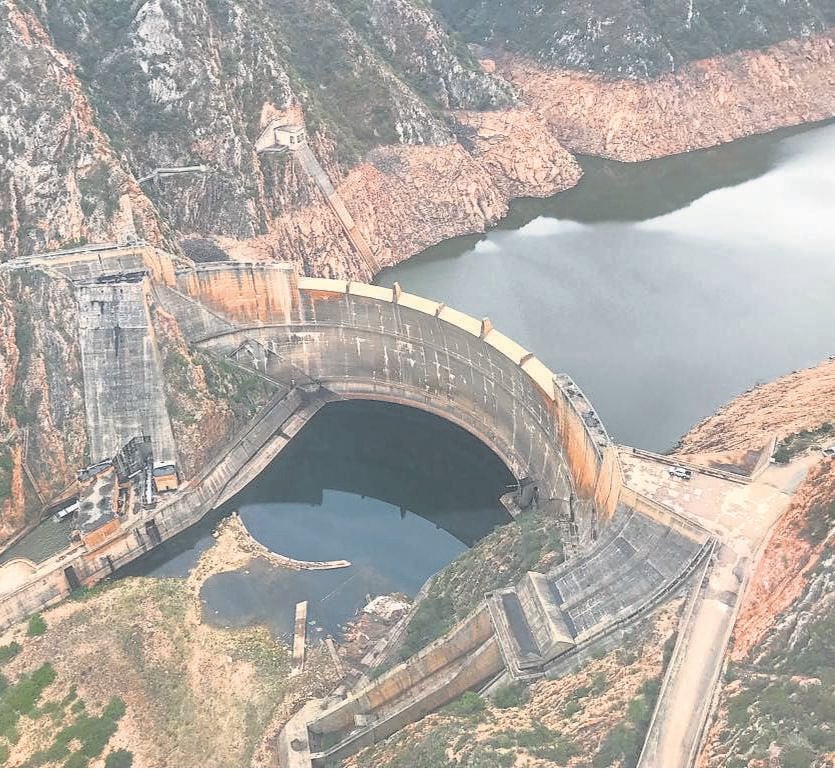


DESPITE floods in the north of South Africa, farmers to the south are grappling with an unprecedented crisis, as one of the Eastern Cape’s largest dams, the Kouga Dam, looks set to run dry for the first time ever.
With the dam level dropping below 7%, the Gamtoos Irrigation Board (GIB) has warned water users that it cannot supply water adequately below the 3% water mark. The dam, which opened in 1969 and last overflowed in 2015, has never dropped below the 6.5% water mark.
CEO of the irrigation board, Rienette Colesky, said that the lowest release level of the dam was 3.1%. “We will, however, not be able to sustainably supply water at that level.”
Colesky said the Nelson Mandela Bay and Kouga Municipalities’ drawings from the dam were curbed to just 30% and 70% of their full water allocations, respectively. Both were honouring these restrictions, she said.
“This situation endangers the citrus harvest for many farmers who might not be able to water their crops further and who do not have access to alternative sources, such as bore-holes.”
Even when farmers substituted their water supply by drilling bore-holes, that water quality was not always suitable for agricultural use, she added. Many farmers have had to outsource the planting of their crops and grazing of their cattle to areas where water is more plentiful.
Cattle and citrus farmer in the valley, Tertius Meyer, said some farmers had already used up their water allocations for the 2020/21 water year, which ends in June, leading to their supply from the dam being discontinued.
“Some farmers are helping their neighbours with water. Some are spending a fortune bringing in water in tankers just to keep their orchards alive. As you drive through the valley, you can see the trees are dry. The fruit size will be affected, which means there will be an abundance of smaller fruit this season,” said Meyer.
A fellow farmer in the valley, Khaya Katoo, said he had had to drill bore-holes to supplement his water supply from the dam.
“We need to mix the bore–hole water with the dam water to make it suitable for irrigation, but the dam water is not enough at the moment,” Katoo said.
“We have reduced our irrigation scheduling to ensure that the youngest trees get enough water and survive,” said Katoo, adding that he had cut back on water usage by 30%, which would mean a harvest of smaller sized fruit later this year.
Noel le Roux farms with his brother in the valley, and together they provide fresh produce for leading retailers nationwide. Le Roux said the scarcity of irrigation water meant they had to use their reduced water quota to keep the citrus going because it’s a permanent crop which makes up 40% of the business.
“We have had to hire ground in areas like Uitenhage, Elandsrivier and Kareedouw, and even as far afield as Steynsburg and Hofmeyr, to plant our fresh produce, to keep our contracts with the grocery chains,” he said.
Gqeberha (Port Elizabeth) Weather Office spokesperson, Garth Sampson, said the region was headed for one of the driest summers on record.
Historically, he said, the highest incidence of rain over the dam’s catchment area has occurred from March to October. However, forecast models were not clear on whether there would be decent rains in the coming months or not, he added.
– Issued by Good News Lab on behalf of The Gamtoos Irrigation Board