

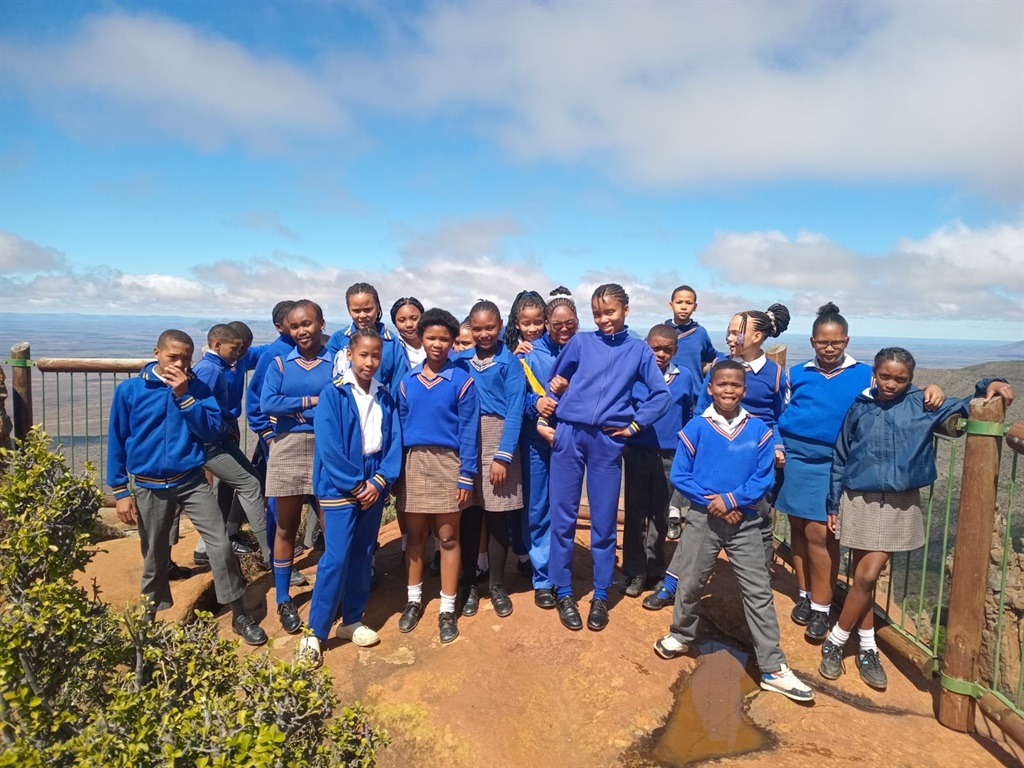
A total of 276 Grade 7 learners and 22 educators from 11 schools in Graaff-Reinet, Aberdeen, and Nieu-Bethesda in the Eastern Cape recently participated in the popular Kids in Parks programme at Camdeboo National Park over a six-week period.
The national programme is supported by the Department of Basic Education, the Department of Forestry, Fisheries and the Environment, and locally by Zakhe-Labs – a non-governmental organisation in Graaff-Reinet.
The groups were hosted at the Park’s Environmental Education Centre just outside the town.
Each school’s two-day programme was aligned, as always, with the national school curriculum.
Although the main focus is on Social and Natural Sciences and Life Orientation, various other subjects are also incorporated into their time spent in the Park. These include Home and First Additional Languages as well as Mathematics.
The orientation of Camdeboo National Park was covered under Social Sciences, including map reading and orientation using the geography of the surrounding area.
The formation of the Valley of Desolation was discussed in-depth while at this natural heritage site, as was the transition from what was formerly known as the Karoo Nature Reserve to Camdeboo National Park.
Back at their base for the two days, the Environmental Education Centre, the youngsters learnt how to construct a simple circuit using solar power and switches to operate a light, fan, or buzzer – practically illustrating what they had thus far only learnt about in books at school. Covering Natural Sciences, the groups explored the ecosystem, food chains, and food webs, and the influences humans can have on them.
These activities took the form of illustrated lessons and educational games.
Groups also examined water as an important natural resource and ways to use less of it both at school and at home.
Additionally, all participating schools were requested to submit a project proposal to be implemented at their schools.
The learners who participated were tasked with being the champions of such projects and urged to take care of them until they move to high school.
The Park’s Socio-Economic Transformation Officer, Matimba Maluleke, said, “Most learners who attended expressed their excitement at visiting the Park for the first time, confirming that SANParks is indeed striving to reach as many people as possible from the local, disadvantaged communities and introducing them to the Park.”
He said many of the educators commented on the quality of the programme, which they said was most beneficial to the learners in terms of the practicalities of how it links up to their curriculum.
