

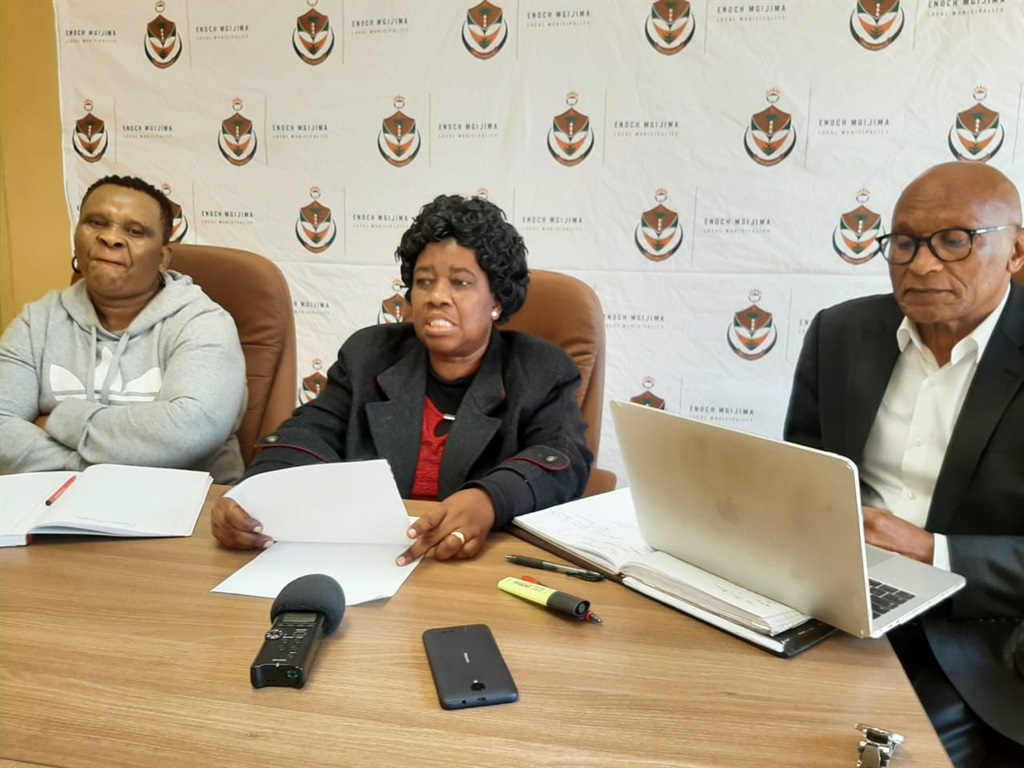
A war of words has erupted at the troubled Enoch Mgjijima Local Municipality (EMLM) between the controversial municipal manager (MM) Nokuthula Zondani and National Cabinet Representative (NCR) Dr Monde Tom with the duo releasing contradicting statements.
However, Tom’s team disputed the municipality’s assertions.
This follows a presentation made by Tom at a ratepayers association meeting in which he said 80% of the local authority’s employees were getting double salaries. Tom said general workers, who were meant to earn R8 000, were receiving R18 000.
Following the presentation, Zondani released a statement saying the local authority had noted, with dismay, the “unprecedented allegations by the NCR”.
“While it is not ideal for the municipality and NCR to send opposing messages in media and other public platforms, the municipality distances itself from the assertions made by Dr Tom as there is no known basis for such a conclusion. It must be noted that there has been no engagement between Enoch Mgijima senior management and the NCR team on the findings made with regards to salaries and other issues,” Zondani said.
She said the municipal management convened a meeting with the NCR and his team on November 8, where it became clear that the NCR team based their conclusions on comparisons made between municipalities and other spheres of the economy.
In the meeting, the NCR refused to confirm his alleged statements as quoted in the media, Mgijima said.
“The NCR could not demonstrate or show any general worker who is earning R18 000 instead of R8 000 or those earning double as what they were supposed to earn as reported. Salaries paid to municipal officials across the country are based on the Task Evaluation and Grading system. Enoch Mgijima cannot determine on its own (and) deviate from the Task Grading system and any comparison made between the salaries paid to municipal officials and workers in the private sector undoubtedly led to the misrepresentations and confusion the NCR created during his remarks to the ratepayers,” Zondani said.
Zondani said Tom did not discuss his “findings” with the management or leadership of the municipality and the municipality called upon Tom to withdraw his public statements and correct the negative public perceptions he created with his “premature” release of his findings.
“The report and its finding are thus rejected, and a passionate plea is made for the NCR and the team to embark on a benchmarking exercise with similar-sized municipalities in the country and then reconsider their findings. Management will at all times be available and ready to engage further with the NCR on any matter affecting the institution at another meeting between the municipality and other relevant stakeholders which include SALGA, trade unions and department of cooperative governance and traditional affairs Cogta,” she said.
Zondani was in the news recently when council took a decision to terminate her contract of employment nine days before it was due to end. Subsequently, less than two weeks, a decision was taken to renew her contract without it being advertised. The DA in the province threatened legal action.
Cogta then said it was illegal to renew a contract without advertising it. Pheelo Olifant, Cogta MEC Zolile William’s spokesperson, said Williams had not been informed.
Zondani was also sentenced to a suspended sentence for contempt of court after the local authority failed to pay its multimillion-rand Eskom debt. The debt is now estimated at R900 million. Zondani, however, appealed and won the sentence.
The Lesseyton stadium saga
The Hawks provincial spokesperson captain Yolisa Mgolodela confirmed that the crime fighting unit had confiscated the cellphones and laptops belonging to Zondani and Chief Financial Officer Paul Mahlasela.
“The laptops and cellphones of both the CFO and municipal were seized to probe further investigation on the Lesseyton saga,” Mgolodela said.
The municipality came under fire when it spent R15 million building a stadium which suspended public protector advocate Busisiwe Mkhwebane said was not worth even R1 million.
“The Municipality is still battling financial challenges which include the huge Eskom debt and NCR was expected to develop a Financial Recovery (FRP) which would address those challenges. The FRP was to be submitted to Council by August this year but has still not been finalised and the municipality has decided to implement its own revenue collection strategy and is able to pay Eskom on a monthly basis without any support from the NCR,” said Zondani.
Underpaid and overpaid employees
In a statement, Tom said the combination of the structure (in EMLM) and job evaluation is the key to resolving both the problem of underpaid and overpaid employees since the amalgamation in 2016.
“This combination will also address the 4% salary increase concerns of some employees as well as the delivery of services problems such as the reliability of the electricity grid, reducing the growth of the Eskom debt and so on. The AS-IS assessment that was tabled to the council and submitted to the National Treasury relates to four baskets plus one problem, including elaboration on overinflated salaries,” said Tom.
He said the FRP process was delayed due to several factors amongst them the need for the reconstruction of records using digital information. The plan, he said, was under consideration by the national treasury and was developed through interactions with management.? ?
The FRP was addressing the four baskets plus one and will replace the 2018 version. The final FRP is now imminent for implementation by the municipality and will address the absence of both the structure and job evaluation.
Tom said the rollout of the implementation of the organisational structure will produce an effective job evaluation that has been absent since the 2016 amalgamation, which resulted in the overinflated salaries of 96% of the total employees in the EMLM.
“The NCR is also working with the municipality to collaborate with private businesses and other stakeholders to strengthen the electricity supply infrastructure. The fit-for-purpose structure and job evaluation will ensure an effective capacitation of the department of electricity,” the NCR said.
“The AS-IS report of the diagnosis and findings of the intervention was presented to the management of EMLM as well as tabled at the Council meeting on June 28, and a resolution was made by the council for management to address matters raised. The municipal department of corporate services provided the current payroll of salaries of all employees. The NCR after comparing the above two sources of data discovered that 96% of the staff at Enoch Mgijima Local Municipality are overpaid,” Tom said.
The NCR said general workers earn up to 32%, and most semi-skilled staff are more than 150% above the national pay scale as per the 2022 South African Local Government Bargaining, Council (SALGBC) for a municipality of the size of EMLM.
ALSO READ | ‘Enoch Mgijima LM on auto pilot’ – National Cabinet Representative Dr Monde Tom
The source of overpayment is the over-grading of jobs using the TASK job evaluation (Tuned Assessment of Skills and Knowledge).
“For example, a semi-skilled job such as a cashier and switchboard operator at EMLM currently earns R27 791, instead of being paid plus/minus R10 820. This accounts for an overpayment of about 157%, which is more than a double salary,” Tom said.
The NCR said the municipality has been short-changed by the management in the last five years since 2016 amalgamation of the three erstwhile municipalities.
“In the interaction between the EMLM management with the NCR team on November 8, only to say they reject the statement made by the NCR that employees are overpaid to the tune of 96% of the staff establishment, the NCR agreed that they can make a media statement, however, they should also provide factual evidence to support their statement,” said Tom.
“The statement issued by the management to the effect that there has not been engagement is not true. In the municipality, the management is yet to be held accountable for the biggest cause of the financial crisis, lack of funds for the delivery of services and diverting of electricity money away from paying Eskom whose debt has accumulated to R916 million,” Tom said.


