

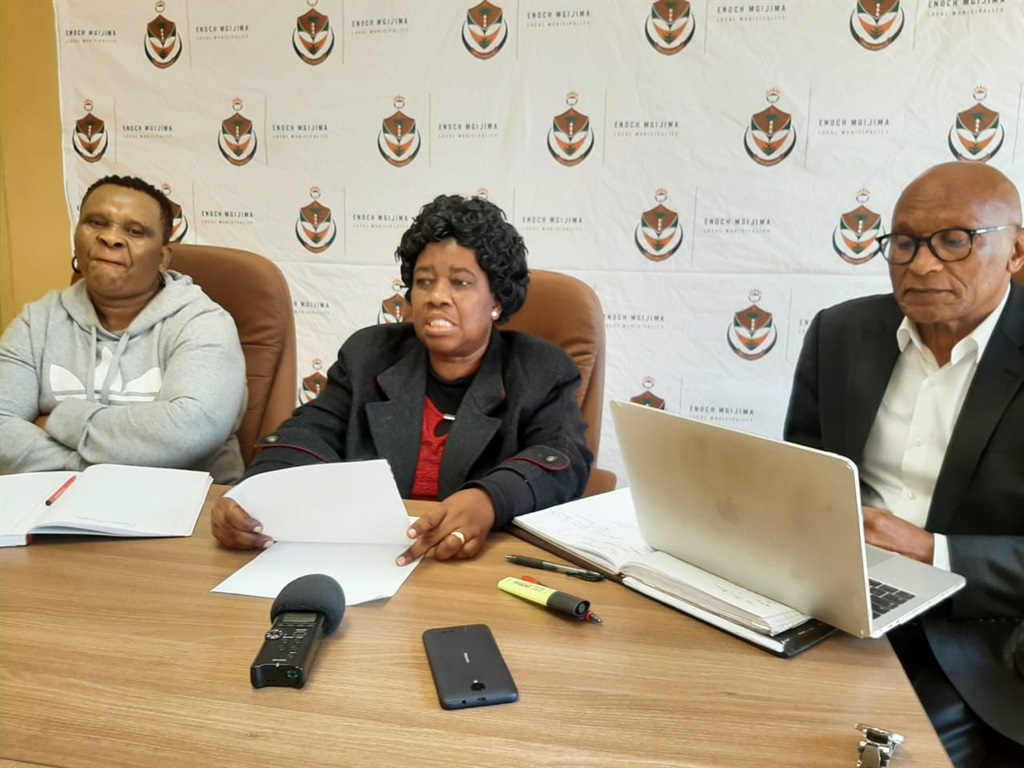
Lack
of appreciation of the critical nature of the national cabinet intervention at
Enoch Mgijima Local Municipality (EMLM) leadership and limited resources, including requisite skills and funding, were some of the challenges faced by the
National Cabinet Representative (NCR).
This
is contained in a report compiled by NCR Dr Monde Tom. The report covers four pillars
that are governance, finance, institutional arrangements and infrastructure and
service delivery.
Tom said the local authority was in a state of prolonged
financial crisis. Tom works with a team of experts with Vuyo Zithumane on
governance, Ismail Mamoojee on finance and Dr Andre Parker on institutional
arrangements. Gideon Henning deals with infrastructure and service delivery,
professor Emil Nothnagel is the project manager with project coordinator as
Saga Poobalan.
Notwithstanding the limited resources and time, the NCR team has carried
out a huge amount of change activities and developed a change strategy, change
plan with stakeholder identification and a communication plan, Tom said.
“The accountability
ecosystem of the municipality has no positive contribution to its operations. The NCR
team concludes that EMLM is on an auto-pilot. The municipality has serious
capacity and technical skills problems to achieve its purpose.
“The
relationships between the city and outside stakeholders are dysfunctional. The
accountability ecosystem has ‘groups who are indebted to one another’ either about employment, so-called deployment, or appointment of service
providers,” he said.
ALSO READ | Enoch Mgijima Local Municipality losing millions in electricity revenue
The team was introduced to the municipality on May 13.
Deliverables of the NCR include issuing directives and instructions to the municipal
manager Nokuthula Zondani and relevant staff to implement the financial
recovery plan (FRP). Others are to provide concurrence on any decision making
reports, develop and implement corrective and control measures, assist and
advise Zondani in the review and reallocation of resources and oversee the
timeous implementation of consequence management.
“The NCR team is to conduct a further analysis on records
management, performance management, Labour relations and contract management,
specifically service level agreements and develop strategic solutions which
will be integrated into the new FRP,” Tom said.
With the municipal budget
having not been funded for the past three years, Tom said there was a gross
overpaid salary budget which needed to be significantly reduced. He said the right
people needed to be in the right jobs to avoid relying on contractors for work
that could be done by employees.
The human resources strategy, which stabilises the management of the
structure, needed to be reviewed “in particular the difficulties faced with
correcting salary overpayment. Interruptions to service delivery occur
regularly due to breakdown of network assets and or vehicles or plant. The response by EMLM to such instances is
reactive in nature”.
Tom
concluded that if there was no resistance, the new FRP would address the
structural challenges faced by the municipality. He said the success of the
intervention was dependent on the full support of the political and
administrative arms of council.
“Collaboration with stakeholders is critical as
the current resources within NCR may not be adequate to address all challenges
that had been anticipated and emerging. This intervention must be supported by strong,
committed leadership which is prepared to invest time, make decisions,
communicate widely and maintain direction – even when challenged.”
He
said the National Treasury forensic unit had to bring in additional expertise
to avoid diversion of the NCR team to investigations and consequence
management.
“Maladministration seems to be an emerging and concerning
phenomena. There is a need for an intensive change management intervention,
however the NCR is limited to communication due to the limitation of resources,”
he said.