

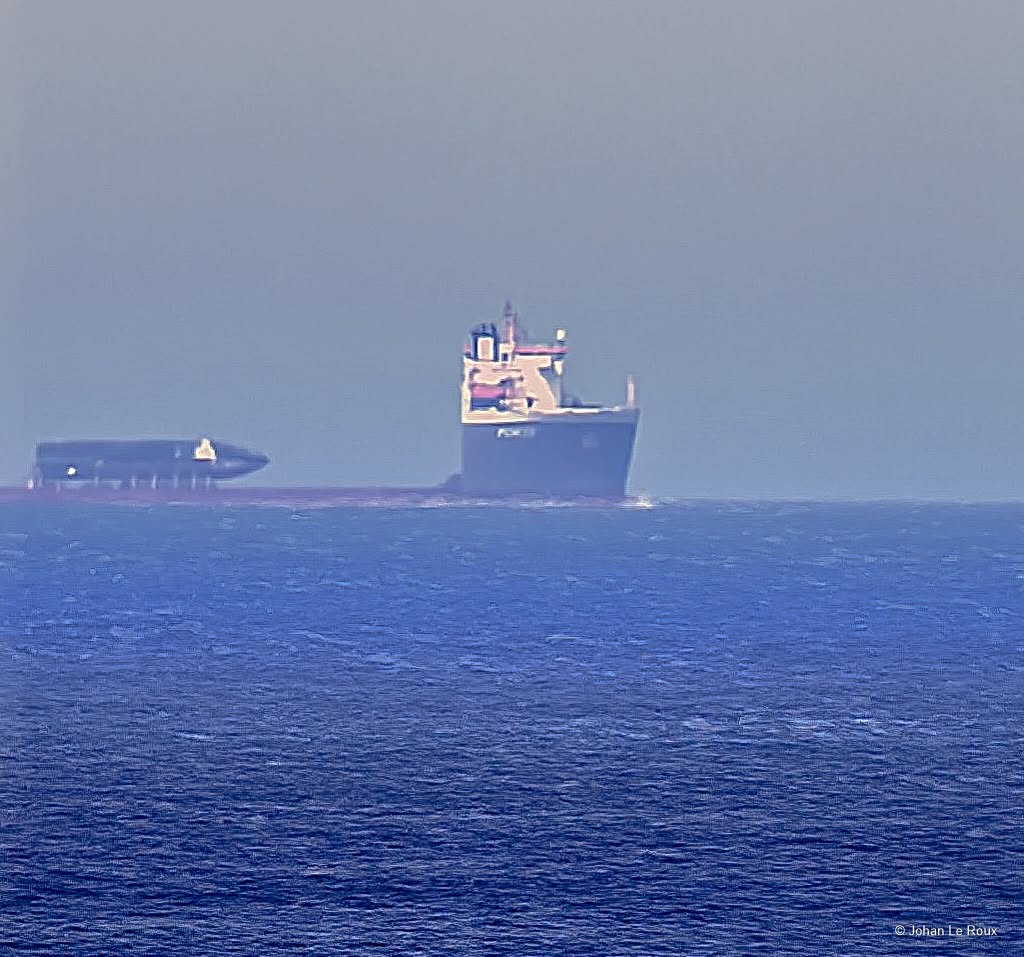
A rare piece of SpaceX hardware made its way around the southern tip of Africa on 15 September as a specialised heavy-lift vessel transports an intact Starship upper stage back to the company’s facilities in Texas.
The semi-submersible cargo ship Forte is carrying Ship 40, a 52.1-metre Starship upper stage that survived its splashdown in the Indian Ocean following SpaceX’s 13th Starship test flight on 24 July.
Vessel-tracking data and footage shared by spaceflight observers show Forte travelling along the South African coast as it rounds the Cape of Good Hope on its approximately 20 000km journey to Starbase, Texas.
The vessel left Christmas Island on 28 August after loading Ship 40 directly from the water. The Australian Broadcasting Corporation reported that Forte was specifically brought in to transport the spacecraft after SpaceX’s recovery team had spent about 24 days guiding the vehicle towards Christmas Island following its splashdown.
Ship 40’s journey began on 24 July when it launched from SpaceX’s Starbase facility in Texas as part of Flight 13.
The test flight deployed 20 Starlink V3 satellites before the upper stage completed a controlled descent and splashed down in the Indian Ocean.
Unlike previous Starship upper stages, Ship 40 remained substantially intact after reaching the water.
The vehicle was subsequently towed to Christmas Island, where SpaceX engineers inspected it before the spacecraft was loaded onto Forte for the return voyage.
Around the Cape
The South African leg forms part of a much longer maritime journey between the Indian Ocean and the Gulf of Mexico.
Rather than transporting the 52m spacecraft by conventional cargo methods, SpaceX is using Forte, a semi-submersible heavy-lift carrier capable of lowering its deck beneath floating cargo and then raising the deck underneath it.
The method allowed the vessel to take Ship 40 directly from the water at Christmas Island. Public vessel-tracking information indicates that Forte is now continuing westward after passing southern Africa, with Brownsville, Texas, listed as its destination.
Community tracking has placed the vessel’s estimated arrival in Texas in early October, although maritime arrival estimates can change depending on weather, routing and other conditions.The unusual sight of a giant SpaceX spacecraft being transported past South Africa has attracted attention from spaceflight observers, particularly because Ship 40 is not simply a discarded test article.
Why Ship 40 matters
Ship 40 flew on Starship Flight 13, the second flight of SpaceX’s third-generation Starship configuration.
The mission was designed to test several systems, including the deployment of the new Starlink V3 satellites and a controlled upper-stage splashdown in the Indian Ocean. The successful survival of the vehicle after splashdown gives SpaceX an opportunity to examine hardware that has experienced launch, high-altitude flight, atmospheric re-entry and an ocean landing.
Ship 40 is listed as 52.1m tall and nine metres in diameter, according to launch-tracking data. The recovery operation also comes as SpaceX prepares for its next Starship test.
The company is targeting 22 September for Flight 14, which is planned as the programme’s first attempt to place Starship into orbit, subject to regulatory approval.
For now, however, the focus is on the previous vehicle slowly making its way home – with Ship 40’s journey taking it directly past the southern tip of Africa before continuing across the Atlantic towards Texas.