
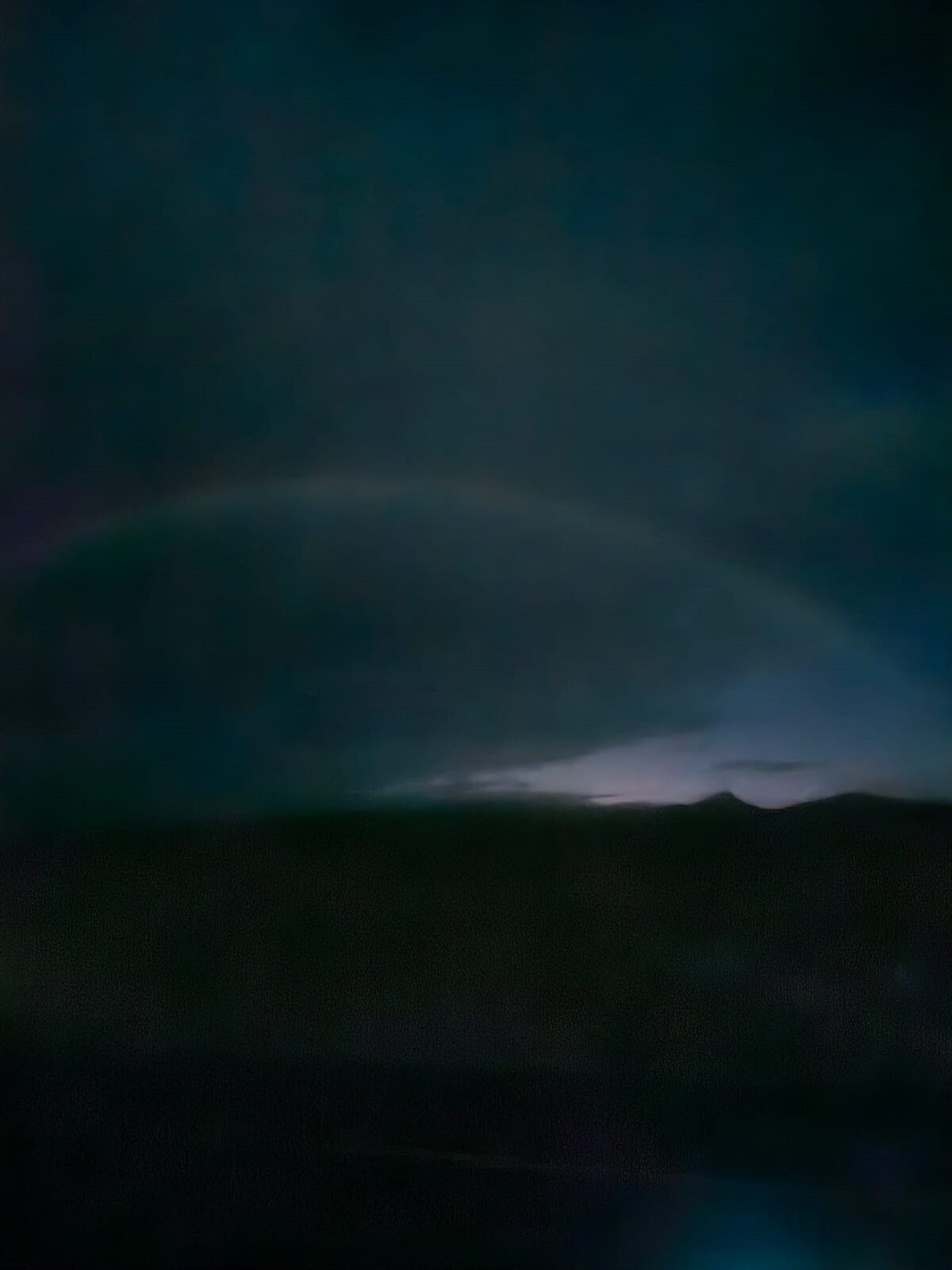
Seeing a rainbow during a full moon is a very rare occurrence. So imagine Roelien Kunz’s excitement when she witnessed what is also known as a moonbow or lunar rainbow while driving between Stanford and Hermanus early morning on Friday 11 July.
“It must have been about 06:40 or 06:45 and we were driving near Vark se Snoet. I was sitting in the backseat when my daughter remarked ‘Wow, look at the rainbow’. I immediately started making a video but it didn’t come out clear. I took loads of photos but only one was clear,” she recalled. “I was absolutely thrilled because I had never heard of something like this, much less seen it.”
Unfortunately she did not manage to capture the full moon as the sky was overcast at that stage.
Wikipedia states that moonbows are created when moonlight is refracted through water droplets in the air, similar to how regular rainbows are formed by sunlight. However, moonbows are much fainter than solar rainbows because the moon’s light is significantly less intense than the sun’s.
The best conditions to see this phenomenon are during a full moon, when the moon is brightest and low in the sky, and when there are clear skies with water droplets present (like near waterfalls or during mist). While moonbows are often perceived as white due to the low light, they can contain the same colours as a regular rainbow, but the colours are much harder to discern with the naked eye.
In short, a moonbow is a beautiful, albeit faint, natural phenomenon that can be witnessed under specific conditions when moonlight interacts with water droplets in the atmosphere.