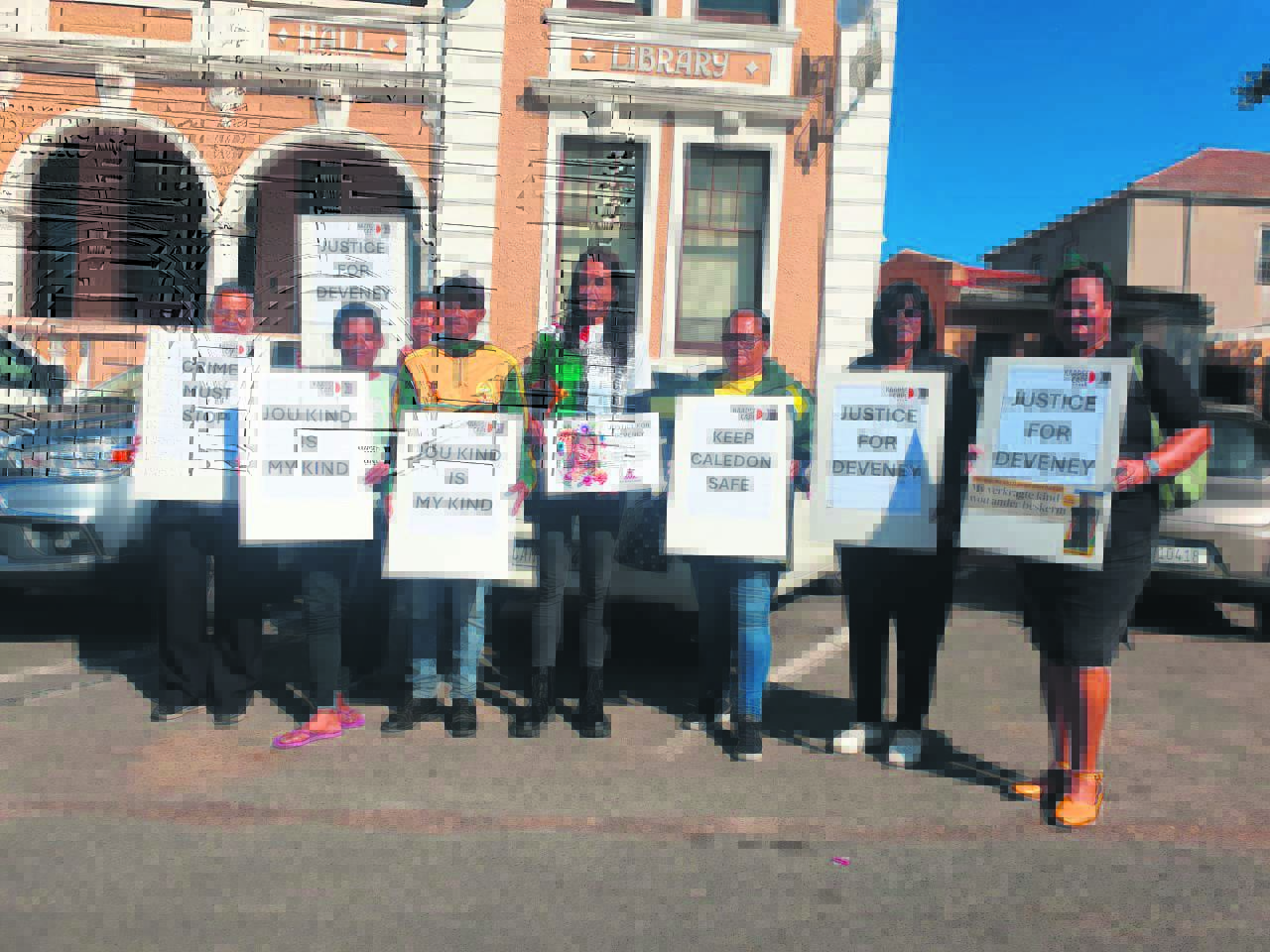


More than 1 400 people signed a petition demanding that the teenage boy accused of Caledon schoolgirl Deveney Nel’s murder not be granted bail and that he receive the maximum sentence without the possibility of parole.
It was handed over to the state when the accused made his second appearance on a charge of murder in the Caledon Magistrates’ Court on Wednesday 18 September. He appeared in camera as he is a minor.
Last week, a much smaller crowd of protesters demanding “Justice for Deveney” gathered in front of the court. Tanya Bippert of the organisation 1 Billion Rising confirmed 1 428 people had signed the petition and demanded that the accused not be held at a place of safety for juveniles awaiting trial.
The Department of Social Development (DSD), however, stated there were no juvenile detention centres in South Africa, as these and reform schools were replaced with Secure Child and Youth Care centres when the Children’s Act came into effect.
Monique Mortlock-Malgas, spokesperson for the DSD, explained: “The latter accommodate children with acute behaviour challenges and youth in conflict with the law. In terms of the Child Justice Act youth committing crimes can be referred for diversion programmes or sentences that vary from community-based sentences to detention in a secure care centre up to the age of 21 years old.”
Whether the accused is held at such a centre until he is 18 or the trial is concluded is for the court to determine, said Mortlock-Malgas.
Eric Ntabazalila, Western Cape provincial spokesperson for the National Prosecuting Authority (NPA), confirmed the 17-year-old had not yet pleaded to the charge of murder.
The minor was arrested on Friday 16 August, hours after he had attended a memorial service for Deveney, whose body was discovered in a storeroom hours after she had been reported missing on Wednesday 7 August.
The memorial service was restricted to staff and learners of Hoërskool Overberg as well as learners’ parents.
Protected by the Children’s Act
Because the accused is younger than 18 he will be prosecuted as a minor in accordance with the Child Justice Act. This also means that his identity might never be revealed even after he turns 18.
The possibility that the accused will receive the maximum sentence should he be convicted of murder is also slim.
“The sentence of a minor is governed by the Child Justice Act (75/2008),” Ntabazalila explained. “The Minimum Sentence Act does not apply to children in conflict with the law. The maximum sentence is 25 years’ imprisonment in terms of the CJA. There is no minimum sentence.”
Asked whether the rape charge that was withdrawn against the murder accused, regarding the alleged rape of a young girl during December 2020 when the accused was only 13-years old, will be reinstated, Ntabazalila stated: “Regarding the rape matter, as the parties involved are minors we cannot comment on the matter.”
The murder case has been postponed to 16 October for further investigation.
Whether more charges may be added to the case and whether it might be transferred to the Western Cape High Court in future, said Ntabazalila, will be determined at a later stage.