
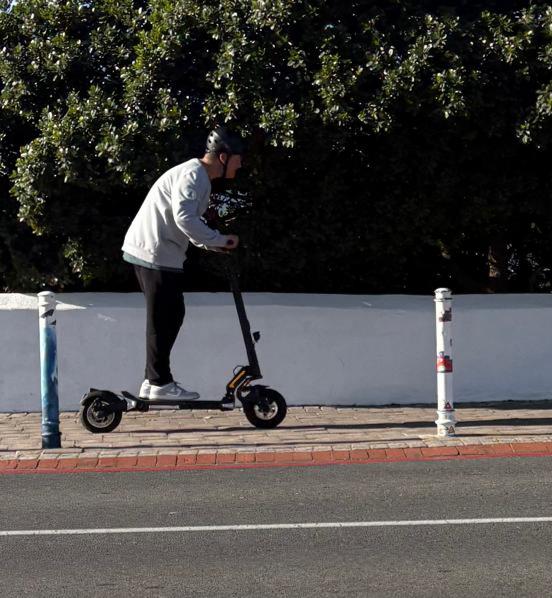
Electric scooters have become more pertinent for some pedestrians across the province. Now they are slowly but surely becoming mainstays in Hermanus. But what does the law say about these modes of transport locally and what regulations are they guided by?
In correspondence with Hermanus Times Overstrand municipal manager Dr Dean O’Neill said there was “no comprehensive national regulatory framework [in place] that specifically governs the use of e-scooters.
“However, the provisions of the National Road Traffic Act, 1996 (Act 93 of 1996) and the National Road Traffic Regulations may apply where an e-scooter falls within the statutory definition of a ‘motor vehicle’.
“In such instances the applicable provisions of the Act and regulations may be enforced.”
E-scooters have been praised for offering an alternative to regular motor-vehicle transport for various reasons such as convenience, cost-effectiveness and eco-friendliness.
However, according to global research, the rapid growth of e-scooters has created new challenges and safety concerns in many cities around the world. Especially when e-scooters share pavements with pedestrians.
Taking to social media, concerned residents have noted how the small wheels of e-scooters “can be unstable on uneven surfaces and collisions with walkers – particularly children and elderly people – can result in serious injuries”.
Such was the case in Sea Point when one resident had to undergo knee surgery after being struck by an electric scooter, according to an article by 2 Oceans Vibe.
For now Hermanus residents and visitors are urged to ride responsibly, respect pedestrians and stay alert to any future regulations that may provide clearer guidance on where electric scooters may legally be used.
A developing area
Meanwhile, in South Africa “the regulation of e-scooters remains a developing area of law”, according to O’Neill.
According to the National Road Traffic Regulations “, ‘motor vehicles’ means any self-propelled vehicle and includes a vehicle having pedals, an engine or an electric motor as an integral part of it or attached to it.
Also, it is designed or adapted to be propelled by means of such pedals, engine or motor, or both such pedals and engine or motor.”
However, these do not include “any vehicle propelled by electrical power derived from storage batteries and which is controlled by a pedestrian”.
This furthermore blurs the line on how e-scooters in the Overstrand may be regulated.
“Given the legal complexities and the evolving regulatory environment,” said O’Neill, “the Overstrand Municipality is in the process of obtaining a formal legal opinion from its Legal Services Department regarding the use of e-scooters and the concerns that have been raised.”
He added that “until this process has been concluded the Overstrand Municipality is not in a position to comment further on the interpretation or application of the legislation.”