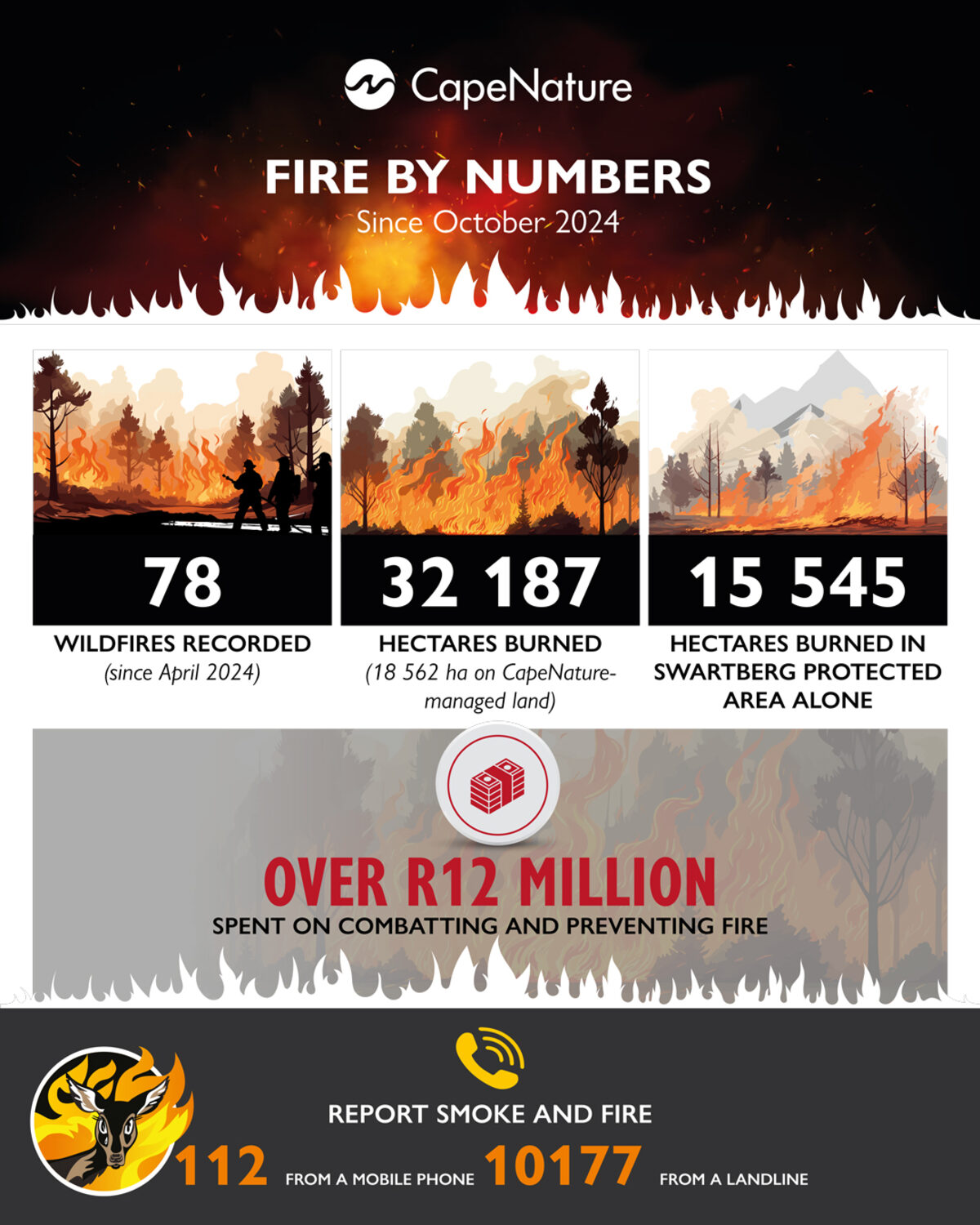


From April 2023 to March 2024, CapeNature responded to 89 wildfires, which saw approximately 73 671 ha, of which 22 762 ha were on entity-managed land, destroyed.
There has been a steady increase in the number of fires the entity has responded to in recent years, with 73 fires responded to in 2022-’23 and 87 fires in 2021-’22. CapeNature was able to contain 54% of the fires in 2023-’24 to less than 10 ha and 21% to less than 100 ha. These are excellent results and were only possible due to CapeNature’s Large-Scale Rapid Initial Attack Approach (LASRIA) response and the collaborative efforts of the Provincial Disaster Management, District and Local Municipalities, Fire Protection Associations, the Working on Fire Programme, Volunteer Wildfire Services and other fire contractors, neighbouring landowners and the public at large.
The LASRIA principles used by the entity when combating fires were effective only through partnerships, and in 2023-’24 it maintained 12 formal memoranda of agreements in this regard. Together with these partners, CapeNature was able to respond quickly with the maximum number of resources and personnel, avoiding an extended fire duration, lasting multiple days, causing great damage and requiring a larger number of resources.
According to Dr Ashley Naidoo, CEO of CapeNature, “not only are CapeNature’s partners critical to contain wildfires, but so are the public that report fires immediately to the correct authorities. When the public alerts the relevant authorities to smoke or fire quickly, a response can be activated before it becomes a larger incident, increasing the chances of success and saving money, time, infrastructure and potentially even lives. LASRIA can mean the difference between minor damage and total devastation, and the role of the public cannot be emphasised enough. I must thank the public for reporting these fires and ask them to continue to report them as quickly as possible by dialling 112 from a mobile phone or 10177 from a landline.”
The public can also play their part by practising fire safety as the warmer, drier months arrive.
Typically, the Western Cape sees most of its fires during the hotter months, with only six occurring during the wetter months (June-September) and the remaining 83 between October 2023 and May 2024.
Open fires, especially during hot, dry and windy days, are a common cause of uncontrolled fires. Preventative measures include having no fires next to roads and passes, and only using designated fireplaces and facilities. Never leave a burning or smouldering fire unattended and avoid starting a fire when it’s hot and dry.
In the 2023-’24 fire season, 55% of fires were started by people, either through negligence or on purpose (braai and warming fires, fireworks, negligent and intentional ignitions), 12% were started by mechanical means (machinery, heavy vehicles, cars, trains, welding, weapons, brush cutters, power lines) and 10% through fire operations such as block burns, stack burns and fire breaks. Natural fires contributed 14% to the total, with 9% unknown or believed to be flare-ups from existing fires that were contained.
CapeNature manages more than 820 000 hectares of protected areas in the Western Cape. The Cape Floral Region is recognised as one of the most special places in the world for plants due to the diversity, density and number of endemic plant and animal species.
Fynbos plants, such as proteas, need fire to stimulate them to release their seeds, which then germinate into new plants. However, many of these plants need more time to mature and set seed between fires. They may be eliminated from these protected areas because of increased fire frequencies.