


The City of Cape Town’s north-eastern Municipal Planning Tribunal has approved a plan to build a large-scale data centre at the King David Country Club.
The tribunal approved the application at its meeting on Tuesday 14 July. The decision was formally closed the following day, on Wednesday 15 July.
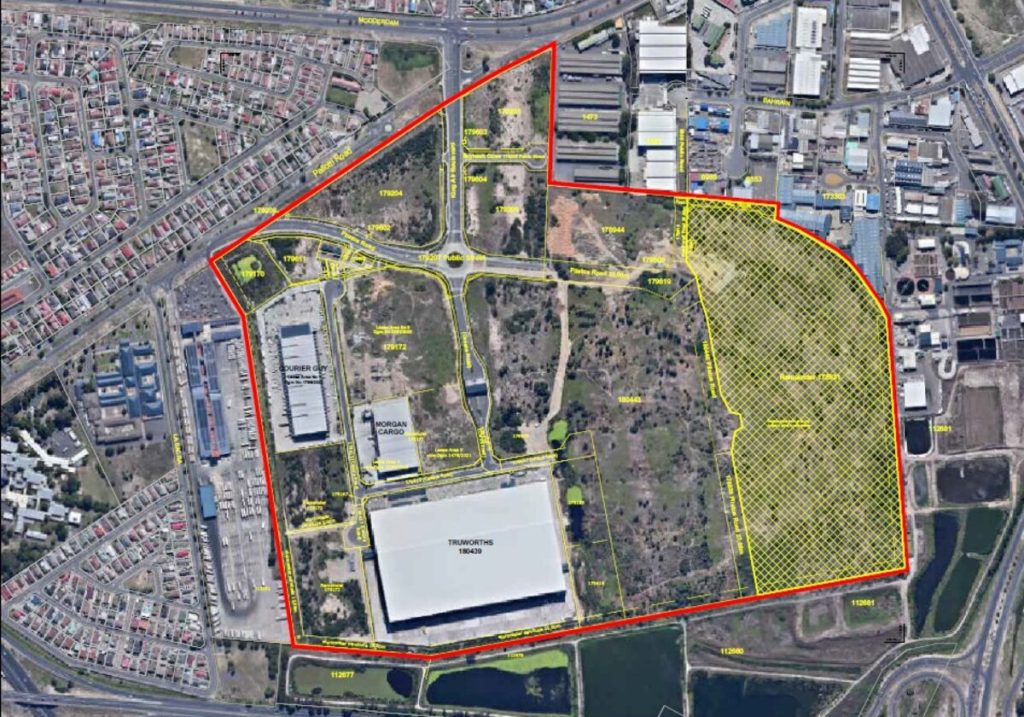
The application, lodged by data centre operator Equinix, allows for the development of two data centres within King Air Industria, including a second facility on newly created land at 90 Pallotti Road. The consolidated site for the second data centre will measure 15,4605 hectares.
The approval covers the rezoning, subdivision and consolidation of several erven to create a single site. It also permits a redistribution of approved gross leasable area within existing development rights to accommodate the new facility. The applicant stated that no new development rights are being created and that the proposal merely reallocates existing rights within an already approved industrial park.
The developer has secured 160 MVA of electricity supply, which has been paid for. The City will provide an additional 80 MVA to a new switching station, allowing for an overall power transfer rating of 240 MVA. The City said this would strengthen and expand its 132 kV network in the area, allowing for more user connections and network redundancy. The new switching station and cable installations will be carried out under a self-build agreement between the City and the landowner, with all construction costs borne by the landowner.
Objectors raise concerns
The application faced opposition from the Legal Resources Centre (LRC), acting on behalf of the Housing Assembly and Foxglove. It was the only objection received during the public participation process, which closed on 13 April.
The LRC argued that the application was presented as a technical amendment but actually introduced large-scale, or hyperscale, data centre development without sufficient supporting information.
They raised concerns about water demand, which they said was not quantified despite the scale of the facilities and Cape Town’s context of water scarcity. They also questioned the energy demand and its effects on the electricity grid and other users.
The objectors said the application was silent on key operational aspects, including backup diesel generation, fuel storage, air pollution and noise. They also expressed concern about the absence of architectural plans and argued that cumulative changes to the approved development rights had substantially altered the nature of the project.
The objection also referred to the broader impact that data centres may have on energy resources in South Africa, given that electricity is largely generated by coal power stations, and the potential environmental impact given Cape Town’s water scarcity.
They asked the City not to determine the application in its current form and to require further technical information, subject to additional public participation before any decision was made.
City departments support the application
Several City departments reviewed the application and indicated support, subject to conditions. These included electricity services, environmental management, fire and rescue, business systems, roads infrastructure management, catchment stormwater and river management, transport impact assessment and development control, and water and sanitation.
The conditions related to engineering services, landscaping, stormwater management and transport assessments, among other matters.
In response, the applicant said the application was appropriate for its stage and that detailed technical information would be provided at later approval stages, including the site development plan and building plan stage.
On water demand, the applicant said water use depends on the cooling technology used and that modern systems may use minimal or no potable water. The applicant confirmed that capacity had been assessed at a planning level, with detailed demand to be finalised later.
On energy, the applicant said 160 MVA of supply had been secured and paid for, with infrastructure upgrades funded by the developer. The applicant said this would improve network capacity and resilience.
The applicant stated that data centres are legally permitted in the General Industry 1 zone and that the 2025 amendments to the municipal planning by-law explicitly include data centres in the definition of warehouse use. The applicant argued that the development remained a light industrial and logistics park and that no fundamental change in land use was being introduced.
Proposal found consistent with planning frameworks
The case officer’s report found the proposal was:
- consistent with the Municipal Spatial Development Framework 2023, noting that the site falls within the Urban Inner Core, an area prioritised for economic activity and the intensification of development;
- aligned with the Tygerberg District Plan 2023, which designates the area for industrial use and supports economic development around the Cape Town International Airport. The report noted that the plan encourages future-oriented industries that enhance the district’s competitiveness.
- consistent with the City’s Inclusive Economic Growth Strategy 2021 and the Social Development Strategy 2013, noting that data centres support digital infrastructure and downstream industries across technology, finance and communication services.
- compliant with the Spatial Planning and Land Use Management Act 16 of 2013, noting that the site is within the urban edge and would not result in urban sprawl, and that the application followed the required planning procedures.
Tribunal’s reasons for approval
The tribunal approved the application for the reasons set out in the planner’s report.
In the report, it was found that:
- the approval would have a positive socio-economic impact, creating employment opportunities during construction and, to a limited extent, during operation and maintenance. The data centre would support digital infrastructure and downstream industries, and contribute to urban integration.
- the proposal is compatible with surrounding land uses, noting that the majority of existing land uses would remain and that a data centre generates less traffic and has less impact on infrastructure than traditional industrial or warehousing uses.
- the support of the City’s engineering departments confirmed there would be no adverse impact on existing engineering services.
- the site holds no heritage grading and that heritage resources were unlikely to be negatively affected.
- the data centre would have a lesser operational impact than traditional industrial uses, as data centres do not generate significant noise, air pollution, vibration or hazardous emissions. Backup power systems, including diesel generators, would be subject to environmental management measures and regulatory controls.
- the proposal was unlikely to negatively affect the existing rights of adjoining and surrounding property owners.
Conditions of approval
The tribunal imposed several conditions of approval.
A site development plan must be submitted before building plans, and will be circulated to relevant City departments for comment.
The developer must submit confirmation that the data centre falls within the scope of the approved environmental authorisation before or at the same time as submitting the site development plan and building plan application.
A landscape plan must be submitted for the consolidated site, to tie in with the approved master landscaping plan for the precinct.
The site development plan must include measures to minimise potable water consumption, with potable water restricted where feasible to domestic and fire protection purposes only.
ALSO READ: King David Mowbray Golf Club development: comment deadline extended to 7 August


You must be logged in to post a comment.