Chris Hani’s first military training was at a Mamre farm, a new authorised biography by Zakes Mda (78) reveals.
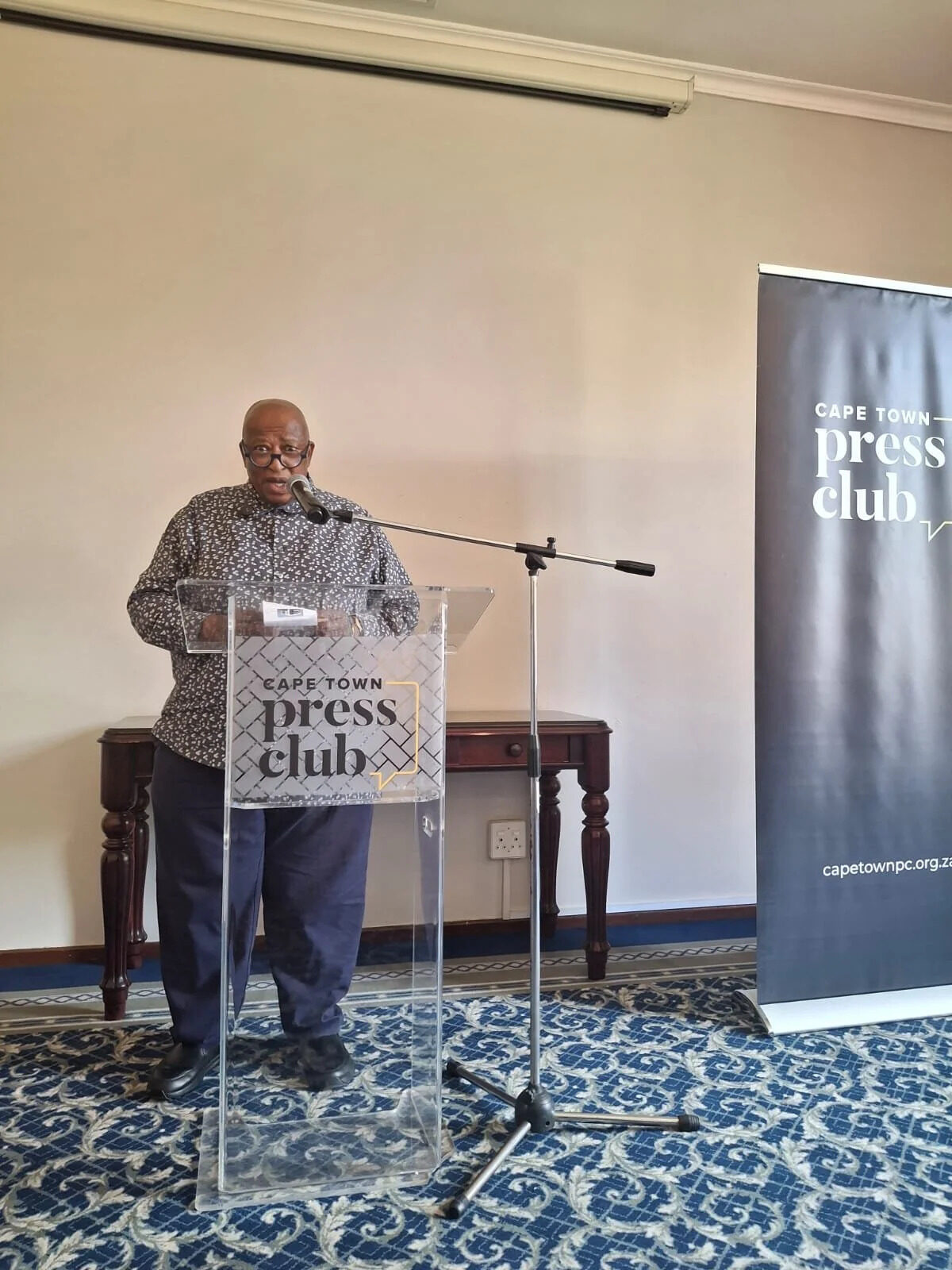
Mda shared the detail at the Cape Town Press Club at Kelvin Grove, Newlands. He was speaking about his new book, Chris Hani: A Life of Courage and Compassion, published this month.
He had learned about the Mamre training camp from struggle veteran Denis Goldberg at the African National Congress (ANC) Mangaung conference in Bloemfontein in December 2012. Goldberg helped establish the camp in December 1962 and trained young ANC members in explosives there, Mda said.
Among them was Hani, who later fought in the Wankie Campaign in then-named Rhodesia and directed underground operations from Lesotho.
“His very first military training was right here in Cape Town,” Mda said. “That farm in Mamre is no longer there. It is part of the city now.”
The Mamre camp is recognised as the first Umkhonto weSizwe training centre inside South Africa. Security police interest forced its closure soon after.
Exile and friendship
Mda’s connection to Hani was personal. Both families lived in exile in Mafeteng, Lesotho, in the 1960s and 1970s.
Mda’s father, AP Mda, a founding member of the ANC Youth League, who later helped form the Pan Africanist Congress, was exiled to Lesotho in 1963. Hani’s father, Gilbert Hani, lived in the same town.
“We all lived in communion with one another, irrespective of ideological differences,” Mda said. “They lived cheek by jowl with other people, participated in the same community activities, sent their children to the same schools, worshipped in the same congregations, celebrated at the same weddings and mourned at the same funerals.”
In 1980 Hani visited his father in Mafeteng and found the community celebrating Mda’s first book, a collection of plays entitled We Shall Sing for the Fatherland.
“When the time comes for me to write about my life I’ll come back to you to write it,” Hani told him. Mda said neither of them took the remark seriously.
A wife’s persistence
The book may not have materialised without Limpho Hani, Hani’s widow. At the Mangaung conference in 2012, she joined Mda and Goldberg, and asked when he was going to write “your brother’s biography”.
Mda stalled. His position as a professor at Ohio University in the United States left him little time. But Limpho pressed him over several years.
She told Mda a senior ANC leader had opposed his appointment as biographer because Mda had come from a different political tradition. The ANC denied Mda access to its archives, forcing him to find material elsewhere.
In a university library in Ohio he found bootlegged copies of Hani’s own writings. Limpho had previously told him the writings did not exist.
The Police and Prisons Civil Rights Union (Popcru) funded the project after the National Institute for the Humanities and Social Sciences withdrew its support.
Speaking truth to power
Mda said the biography showed Hani challenged those in power, including within his own organisation. He wrote what became known as the Hani memorandum, exposing corruption in ANC camps in Angola. The ANC sentenced him to death by firing squad as a result. ANC president Oliver Tambo intervened to stop the execution. Hani suffered a mental breakdown afterwards. Friends in Zambia took him in and arranged treatment.
“That is the advantage of an authorised biography,” Mda said. “You get access to the old lady who looked after him in Zambia when he had completely lost his mind.”
Mda refused to sanitise the book, despite pressure from an ANC veteran to remove unflattering details about Tambo and Tokyo Sexwale. He agreed to remove only one detail because it could have harmed an innocent person who was still alive. “I believe that if you cannot tell the truth about yourself you cannot tell it about anyone else,” he said.
The talk took place on Mda’s 78th birthday.
Cape Town launch
Mda launched the book at The Book Lounge in Roeland Street last Wednesday (7 October), in conversation with Sam Longford, a research fellow at the University of the Western Cape’s Centre for Humanities Research.
ALSO READ: Christo Brand Mandela friendship: Lessons of reconciliation and humanity