


It is often said the problem with rankings are the people that do them.
This is the uncomfortable truth that hangs over every attempt to definitively rank school rugby teams in South Africa, where the concentration of talent, tradition, and tribal loyalty makes ranking systems as contentious as a forward pass call in a derby match.
At The Rugby Factory, we’ve waded into these treacherous waters with eyes wide open, fully aware that no matter how meticulous our methodology, someone’s favourite school will feel hard done by. But that’s the beauty and the beast of school rugby rankings, they spark debate, fuel rivalry, and give every team something to prove.
The methodology behind the madness
Let’s be brutally honest: there are no official rankings at school level. No governing body sanctions them. No algorithm can perfectly capture the ebb and flow of teenage rugby, where a team can look world-class one week and lose to their arch-rivals the next.
What we have done is strip the analysis down to fundamentals. We’ve looked exclusively at first XV performances from the current 2026 season. We’ve factored in strength of opposition—because beating a top-five school carries more weight than dispatching a team from three divisions down. We’ve watched the matches, scrutinised the scorelines, and assessed the quality of rugby being played.
But here’s the caveat: any rankings at schoolboy level, regardless of how they’re compiled, are an educated guess at best. There is no formula that accounts for injuries, weather conditions, home-ground advantage, or the intangible factor of a team peaking at exactly the right moment.
We don’t pretend to know everything. This is simply what we think based on the evidence before us. Do you agree? That’s the question we want to spark. Here are our rankings for 16 April.
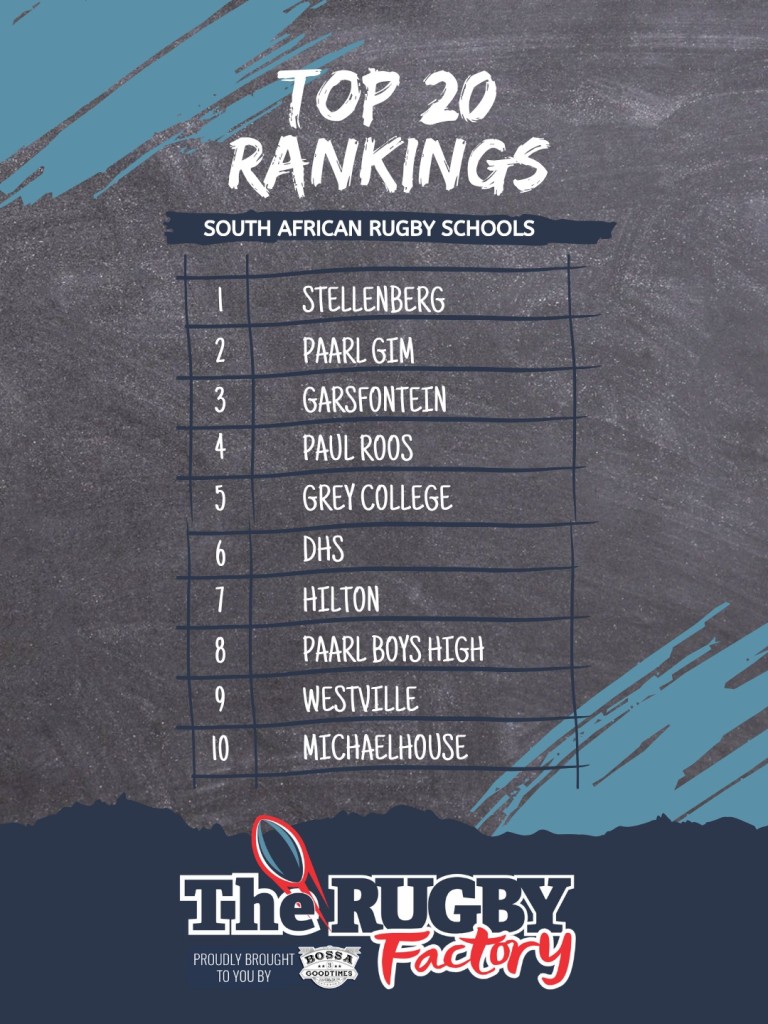

Affies at 11 will raise eyebrows among those who believe the Pretoria giants belong in the top 10. But rankings are snapshots, not destiny—Affies have the pedigree and the playing roster to climb, and their upcoming fixtures will test whether they can gatecrash the elite.
The problem with rankings – And why we do them anyway
The further down you go, the more difficult it becomes to separate teams. Is the 15th-ranked team definitively better than the 18th? Probably not. On any given weekend, those positions could flip.
Regional bias is unavoidable. Western Cape observers will always rate their schools higher. KZN will argue their approach is superior. Gauteng will point to their depth and resources. The Free State will remind everyone that Grey College exists.
Then there’s the fixture list problem. Not every school plays the same opponents. Some face murderers’ row schedules packed with top-10 teams. Comparing records becomes an exercise in contextual interpretation rather than pure mathematics.
So why rank teams at all if it’s such a fraught exercise?
Because it matters. Because it gives players something to strive for. Because it creates narratives and storylines that make the season compelling. Because parents, coaches, and Old Boys need something to argue about over Saturday afternoon braais.
Rankings drive teams to schedule tougher opponents, to seek out the challenges that test championship credentials. They create targets, both for teams chasing the top and those defending their positions.
A living, breathing debate
These rankings are not set in stone. They’re a conversation starter, a provocation, an invitation to watch the games and form your own opinion.
We’ve made our call based on current form, strength of schedule, and quality of performance. We’ll be wrong about some teams. We’ll be vindicated about others. That’s the nature of the beast when you’re ranking 18-year-olds playing a game where momentum swings faster than a Cheslin Kolbe step.
The beauty of school rugby is that rankings get settled on the field. Every weekend provides fresh evidence, new data points, and another chance for teams to prove the rankers wrong.
That’s why we love this game. That’s why we rank them. And that’s why, despite all the problems with rankings, we’ll keep doing it.
Do you agree with our Top 20? Let the debate begin.




You must be logged in to post a comment.