
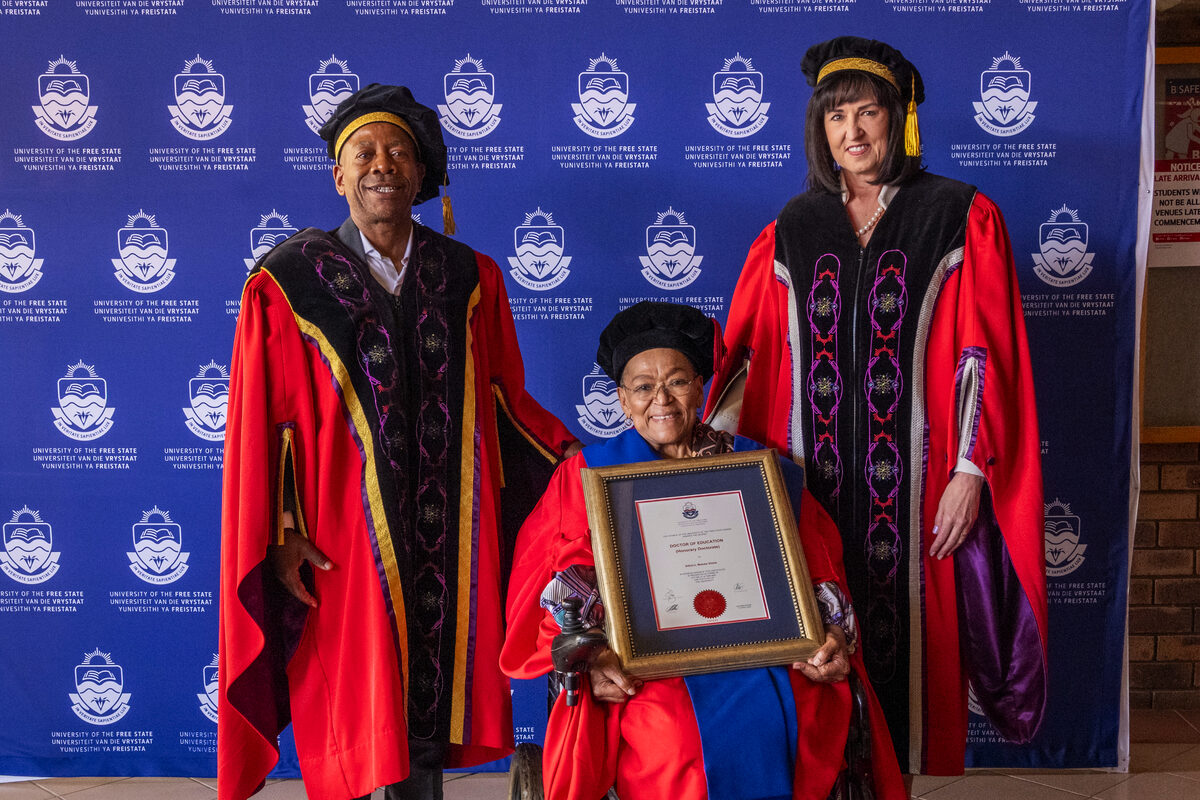
The University of the Free State (UFS) rolled out the red carpet for Dr Sheila Sisulu, honouring her with a coveted honorary doctorate in Education at the graduation ceremony held at the Qwaqwa campus on Friday 10 April. The university acknowledged her immense contribution to education, development, and social justice.
Other distinguished women recognised at separate graduation events were Prof. Relebohile Moletsane, who was awarded an honorary doctorate in Education; Ingrid Winterbach, presented with an honorary doctorate in Literature; Zukiswa Wanner, recognised with an honorary doctorate in Literature; and Prof. Anmari van der Westhuizen Joubert, who was presented with the UFS Council Medal for her work in classical music education.
For Sisulu, the ceremony became something more than just a celebration of qualifications. It translated into a moment to recognise a life shaped by service. In her official welcome, Prof. Hester Klopper, vice-chancellor and principal, contextualised the moment within the purpose of the day.
“We are also honoured to bestow the honorary Doctor of Education degree on Dr Sheila Sisulu in recognition of her distinguished contributions to education, public service, and social development,” she said.
Her remarks connected the honour to the broader role of the university – not only to graduate students, but also to recognise leadership that shapes society beyond institutional boundaries. Yet, when Sisulu stepped forward, she gently shifted the focus away from herself.
“I’m very honoured – more than honoured,” she said, pausing with a quiet laugh.
“When one is honoured, you become shy … you think, really?”
Rather than treating the doctorate as a culmination, she spoke about it as a responsibility.
“It is not just a hat and a gown and a hood,” she said.
“Now I have to remember that I am part of this distinguished university … I must not embarrass the university. In fact, I must raise its flag.”
In a hall filled with graduates – many of whom had overcome significant challenges to reach this moment – the humility of that reflection carried weight.
Klopper had already acknowledged that journey.
“Many of you are the first in your families to attain a university qualification. That alone is a remarkable achievement, and one that will echo through the generations that follow you,” she told the graduands.
Sisulu built on that recognition, turning her attention directly to them.
“You have worked hard – some of you for a very long time – to be here today,” she said.
“But behind you, you have family, your parents, your partners, your friends … they have walked with you.”
Her message echoed the university’s emphasis on graduates as contributors to society. In her address, Klopper reminded students that their education carries purpose beyond personal success.
“Our mission is to create responsible societal futures – and you are the living embodiment of that mission,” she said.
Sisulu’s message to graduates took that idea further, drawing on an image she attributed to former President Nelson Mandela: climbing a mountain.
Reaching the summit, she said, allows you the opportunity to pause and take in the view – but it is not the end.
“You go into the valley and conquer the next mountain.”
For graduates, this moment marks both achievement and continuation. Learning, she reminded them, does not stop with a degree.
In recognising Sisulu, Klopper said, the university affirmed a caliber of leadership that connects knowledge to real societal change.