
For blind and visually impaired visitors, enjoying South Africa’s (SA) coastline has often meant being able to physically reach the beach. However, it has not necessarily meant being able to access the information surrounding it.
Now, the country’s coastal signage is taking a major step towards inclusion.
Braille has been built into a new generation of interpretive signs that allow blind and visually impaired visitors independent access to information about the country’s coastline.
The breakthrough follows the unveiling of SA’s first Braille coastal interpretive signs at Eerste Steen in the Blaauwberg Nature Reserve earlier this year. Blind people worked directly with Blind SA on the design.
Signs unveiled in Hermanus
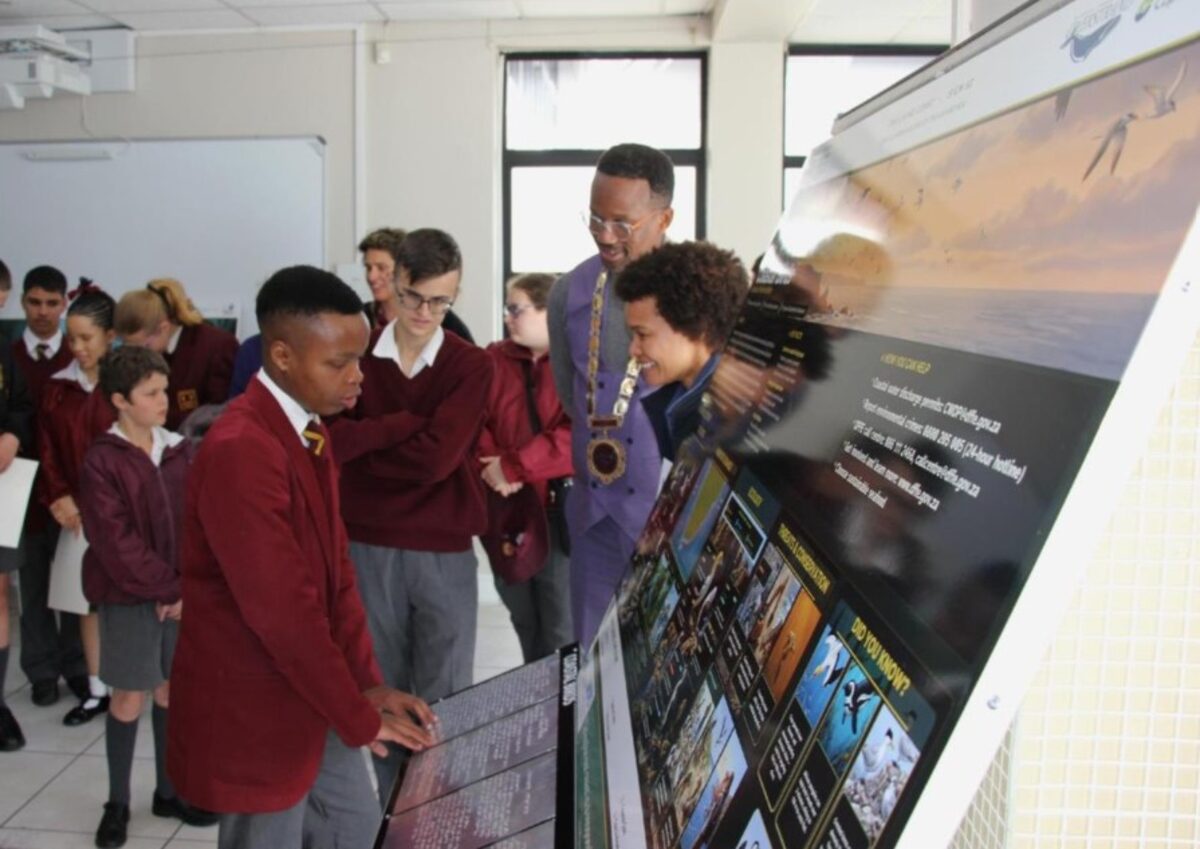
Seven new prototype Living Coast signs were also unveiled at Grotto East beach in Hermanus on 6 October.
The signs form part of a new series aimed at making coastal information accessible to people with disabilities. They are also for children and visitors who speak different languages.
Overstrand Mayor, Archie Klaas noted that the new addition is about more than just recognising the natural environment. “It is also about ensuring that everyone has the opportunity to understand, experience and enjoy it,” he said.
Ryan Peter, Director responsible for Coastal Development and Coordination at the Department of Forestry, Fisheries and the Environment (DFFE) said the project addresses a form of exclusion that has often gone unnoticed.
“The seashore and sea are coastal public property owned by the state for the benefit of all South Africans, giving everyone the right of reasonable access,” said Peter.
Peter added that “while we spent many years fighting to establish the principle of physical access, we have ignored a different kind of exclusivity. A coast which one can reach but cannot comprehend.”
Designed with accessibility at their core
The Living Coast signs are designed with accessibility at their core.
They feature highly readable text, a specially designed typeface for people with poor eyesight and an anti-glare coating. In addition, the anti-glare coating improves visibility in strong sunlight.
An independent accessibility rail is positioned at seated height so that wheelchair users, children and blind visitors can engage with the information themselves.
“This national coastal signage initiative is an important step towards making our coastline more accessible to everyone,” said Klaas.
Braille plates are manufactured and verified by Blind SA and use uncontracted Braille. This allows newer Braille readers to use them. Language barriers are also tackled with the new system.
The signs can be produced in English, Afrikaans, isiXhosa and isiZulu without changes to the overall design.
Hermanus prototypes currently feature English and Afrikaans alongside Braille.
Wider digital access
QR codes on the signs will provide access to a wider range of digital information.
These include audio tours, a species guide featuring more than 279 original illustrations. They also feature coastal quizzes, citizen-science information, visitor information, coastal policy guides, tide and weather information and beach-safety advice.
Audio versions will provide an alternative for visitors unable to read the physical signs. Sychronised subtitles have also been developed for people with hearing loss and visitors who prefer to read along.
The seven Hermanus signs will be tested before the system is rolled out nationally.
Wildlife and Environment Society of South Africa (WESSA) CEO Cindy-Lee Cloete said that the Living Coast prototype signage initiative reflects the organisation’s continued commitment to connecting people with nature. Additionally, it is creating more inclusive pathways into environmental education and conservation. WESSA a non-government environmental organisation marks its centenary this year.
DFFE plans to consult Blind SA, the National Council of and for Persons with Disabilities, Pioneer School learners and Overstrand residents to identify problems an improve the designs.
More signs to be included
The full Living Coast series is planned to include 97 signs stretching from the West Coast to northern KwaZulu-Natal.
It aims to cover environments such as estuaries, dunes, kelp forests, coastal bird habitats, communities and reserves.
“We need to listen to the people that experience the landscape in a lived reality every single day,” said Cloete. “They need to be able to guide us to make sure that our intentions are good enough.”
For Peter, the project represents a broader change in how South Africa thinks about access to its coastline.
“Our coast belongs to all of us,” he said. “A sign may seem like a small thing, but it is one of the first things telling a visitor whether [they are] welcome.”