

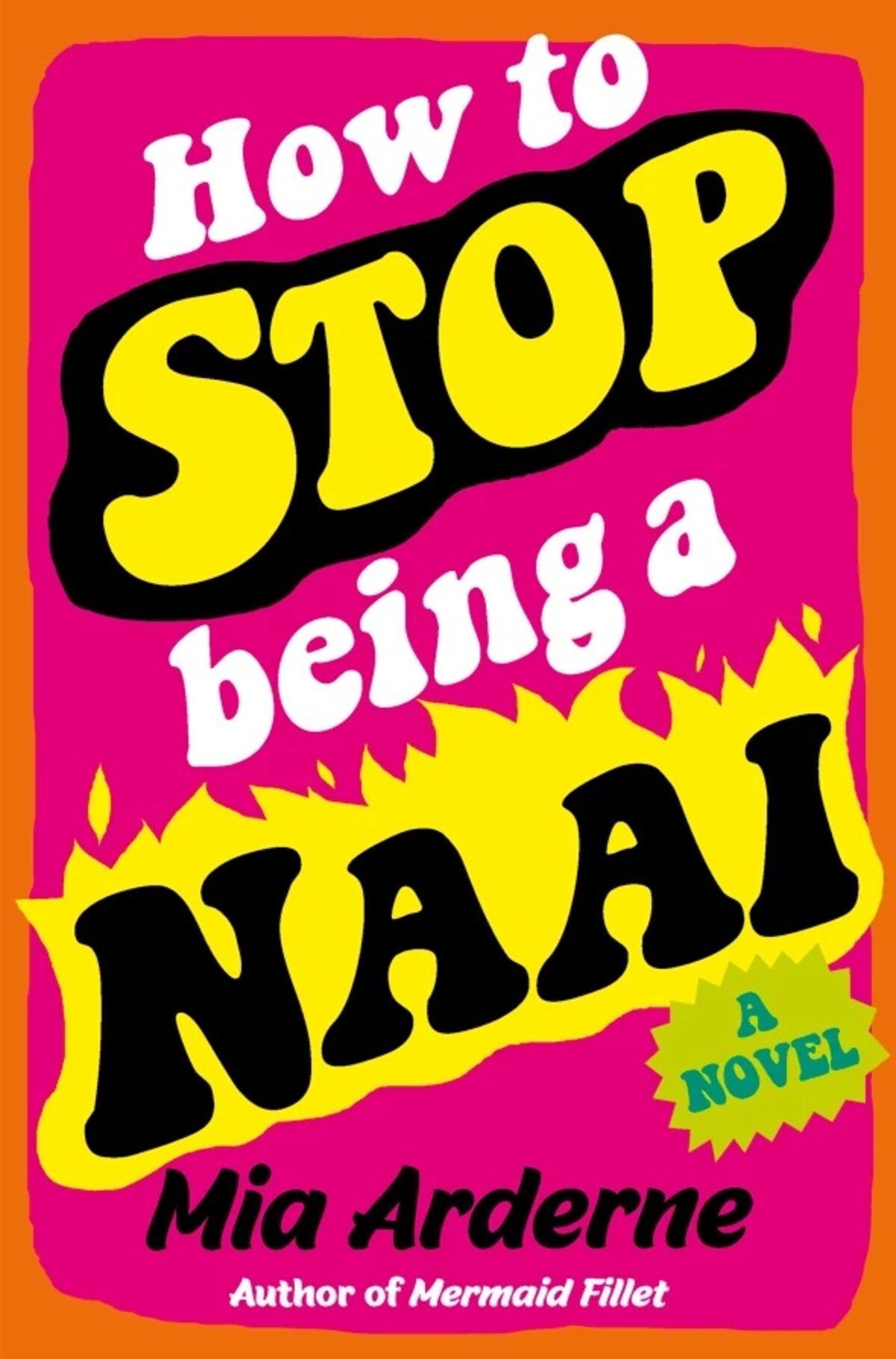
Mia Arderne created the distance she needed to recover from traumatic experiences by shifting them onto a n***erige book character named Lucian.
“It helps to have a protagonist because you can externalise yourself and your experiences. It’s easier to have a character go through the tougher stuff. It doesn’t have to be so intense,” she says.
However, the author picked up some secondary trauma while researching the barbarism of an apartheid-era torturer for her latest novel, How to Stop Being a Naai.
“I ended up reading the TRC transcript,” she said. “I read the whole thing. I haven’t recovered.”
The result is a story that takes dark turns but still maintains the laugh-out-loud satirical humour the title promises.
“I wasn’t trying to get super heavy with it,” Arderne said. “But I ended up going down like rabbit holes and becoming deeper and more sincere at places I didn’t really expect.”
Who is Mia Arderne?

Arderne is a young writer based in Mowbray, Cape Town. Her debut novel Mermaid Fillet, was long-listed for the Sunday Times/CNA Literary Award in 2021 and taught as a prescribed text at the University of Cape Town from 2022 to 2024. She has also written a young-adult romance, A Thousand Eyes on You, and several short stories. How to Stop Being a Naai is her third book, which she wrote after a period of being “institutionalised,” working on her mental health.
What is How to Stop Being a Naai about?
Arderne said the book began as a personal guide of nine steps to becoming a better person. The cover synopsis describes Lucian as a “Philanderer. Alcoholic. Sell-out.”
“Lucian stumbles his way through nine steps – from ruthless self-acceptance to ultimately channelling his inner naai,” it reads. “In other words, he will try anything except go to actual therapy.”
Curiously, Arderne said the character of Lucian is based on herself, “… maybe more than I would like to admit.”
She also drew on her own family history.
“I drew quite a bit on the paternal line of my family because I learnt some toxic behaviour from them. A lot of those people are no longer with us. I was, like, speaking to ghosts a little bit.”
The process was both healing and painful.
“There’s an element of that which was maybe more healing than traumatising. And there’s also a mourning; like, you grieve for these people again when you mine those relationships and those memories.”
The book also went deeper than expected. Research for a character named Archie led her to explore apartheid-era South African Defence Force soldiers, how they interacted with one another and the kinds of crimes they committed. In the end, what started out as a satirical self-help book turned into a novel that explores morality through deeply flawed characters.
“You could replace that word,” Arderne says, referring to the title. “With morality or a measure of morality. We all have lines that we get to where we’ll say ‘now this is over the line for me. This is immoral for me.’ I wanted Lucian to represent the weaknesses we all have. He’s representative of my weaknesses, people’s weaknesses.”
Not a self-help book
Publishing the book came with a lot of surprises for Arderne. The first was the interest from her editor.
“I spoke to my editor and my publisher almost, like, in jest and she was, like, ‘okay, send it through.’ I did. It was just a guide. It was just nine steps. And then she was, like, ‘look, I think you need to add a character.’ So Lucian came.”
The next surprise was people’s reaction to the book.
“I have a lot of people who want to buy it for other people in their lives because they have n***s in their lives that they think need this help,” she said, adding that she frequently needs to remind people that this is fiction and not a real self-help book, despite a disclaimer inside the book .
“It says on the cover it’s a novel, but I think it reads as a self-help book. I really hope they’re not expecting real advice. I mean, I’m not a psychologist.”
Social-media posts also attracted a lot of surprising ire.
“Some guys are quite defensive about Lucian. A lot of the men commenting were, like, “why are you dragging this guy”, not realising it’s a fictional character. You’re defending someone who’s not real.
“And then I have all these Lucians in my comments, just lots of guys named Lucian who were not happy with me. And I’m, like, it’s just a name.” Mia said she chose the name because it was one of her favourites, ironically. “The Lucians of the world are not happy with me, man. They are not happy with me at all.”
Conversely, women have commented on the social-media posts lambasting the character as a “f**cker”.
Well received
Overall, Arderne said the book has been well received and sales at the recent launch were good, but she jokes it may well have been because of the “provocative” title.
The most common reflection, though, is that the book is funny.
“Most of the feedback I got was that it was quite funny, and yet my writing isn’t generally funny. So it’s been quite cool to hear that.”
Mostly, though, people have said they related to the characters, especially Lucian.
“People tend to sympathise with Lucian more than I would have thought,” Arderne said.
ALSO READ: Goodwood author celebrates bestseller success with new romance novel

You must be logged in to post a comment.