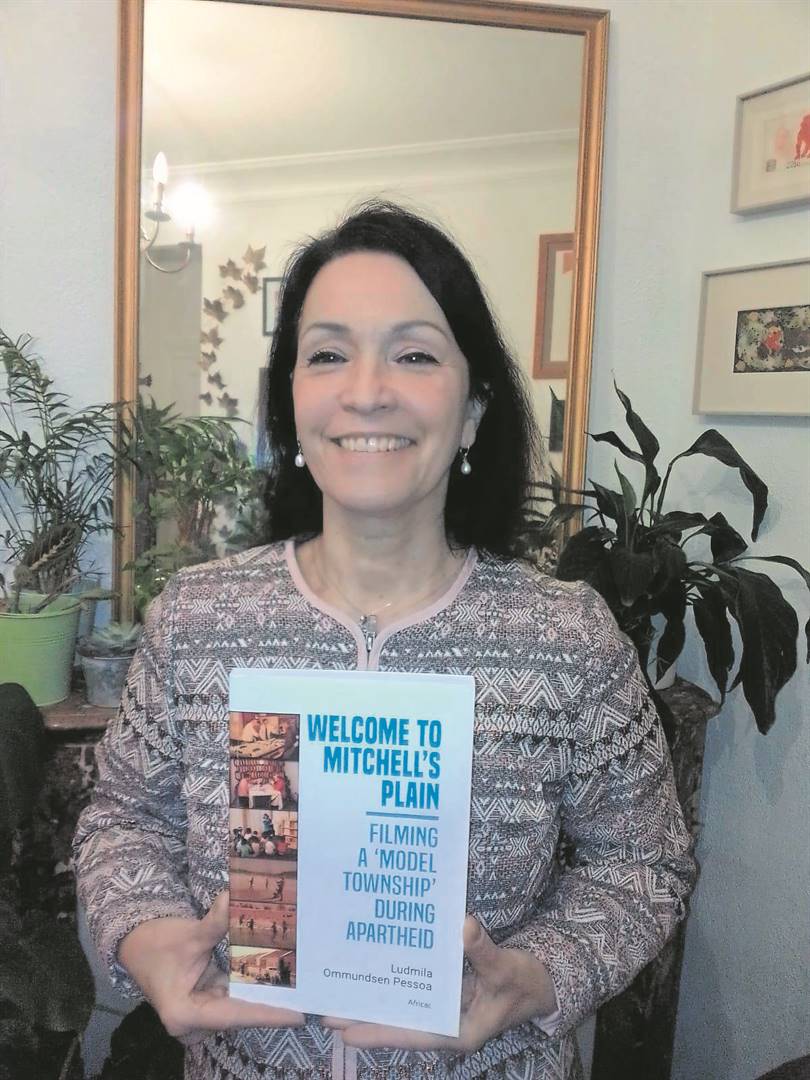
A former director of the Alliance Française in Cape Town and Mitchell’s Plain (2008-2013), Dr Ludmila Ommundsen Pessoa, researched a book on Mitchell’s Plain, Welcome to Mitchell’s Plain: Filming a ‘Model Township’ during Apartheid.
The book chronicles the fortunes of Mitchell’s Plain: its conception and role as propaganda for the apartheid regime.
Pessoa explains: “Under the apartheid regime, Mitchell’s Plain was devised as a ‘model township’. A cutting-edge urban planning scheme would provide middle-class Coloured people – evacuated from their homes by racialised rehousing programmes – with exemplary living conditions.”
She says this “flagship for the regime” was inaugurated with fanfare in 1976, and heavily publicised not just within South Africa but also in the international press.
“Cohorts of political leaders and journalists were invited to admire first-hand how racial segregation could be paired with progressive social planning. A documentary film was commissioned for worldwide distribution, Mitchells Plain (1980). That is why the title of the book is Welcome to Mitchell’s Plain: Filming a ‘Model Township’ during Apartheid.”
A senior lecturer at the University of Le Havre-Normandy in France and a member of Groupe de Recherche Identités et Cultures, Pessoa’s research focuses on South Africa’s contemporary literature and culture, and 19th-century British women’s South African travel narratives.
As a former director of Alliance Française Mitchell’s Plain, she started collecting information when she arrived there in 2008.
“I was struck by the paucity of work on Mitchell’s Plain except for the few surveys on education or socio-economic conditions. Nothing in the area of history as if the place had none. I then began consulting documents at the Rocklands Library and then at the National Library in Cape Town.
“I realised that Mitchell’s Plain had a history of its own. Not a banal one.
“During apartheid, Mitchell’s Plain had been a strategic site for both the apartheid government and protest movements.”
In 2018, she discovered that a film on Mitchell’s Plain had been commissioned in City Engineer Jan Brand’s 1980 report. Pessoa immediately contacted the National Film, Video and Sound Archives (NFVSA) to check if it had been made.
“The NFVSA and the Government Communication and Information System (GCIS) were interested in my project, therefore they provided me with a digital copy (the original version is on reels),” Pessoa says.
The material revealed some interesting facts, the first being that the “model township” had received the “Award of the Most Outstanding Civil Engineering Achievement of 1979”.
“Contrary to other contemporaneous housing projects (for example townships), Mitchell’s Plain boasted two interesting innovations that made it a specific collaborative project with design intentionality and cultural inscriptions,” she says.
The first was a survey of potential owners’ tastes and preferences after which the planning division of the Cape Town City Council created some 70 house designs for Mitchell’s Plain.
The second innovation was a competition for the design of approximately 165 dwellings and their layout sponsored by Messrs Everite Limited and promoted by the City of Cape Town.
“Other interesting information is that in his 1972 report, City Engineer Morris pointed out that the early selection of a suitable name for the town was extremely desirable. The development project, being equal in magnitude to many of the new towns of Britain and Europe, and representing a major extension of the far eastern boundary of the City of Cape Town, it was recommended that the name Goeie Hoop should be adopted for the whole town.”
The recommendation highlighted in Morris’s report, however, was not implemented thus saddling all sub editors everywhere with a spelling conundrum.
“Since the very first report on its planning the name of the location has been spelt either ‘Mitchells Plain’ (no apostrophe) or ‘Mitchell’s Plain’ (with apostrophe).
“The spelling varies according to the sources cited. Both spellings can also be found in the same source,” she says.
On receiving the digital copy of the film, Pessoa contacted Janine van Rooy-Overmeyer, founder of the non-profit organisation Blaqpearl Foundation.
The organisation helps youth cope with the harsh realities of life through arts.
Together, they organised a screening and a debate in 2019 (https://www.news24.com/News24/propaganda-film-aired-20190311) as part of a research project.
Pessoa says the aims and scope of the initial research project were meant to be much broader, including many interviews based on people’s reactions to the documentary’s images.
“Unfortunately, the sudden Sars-CoV-2 pandemic and its aftermath prevented the original plans from unfolding as expected.”
She revised the initial project and decided to focus on the importance of creating a new narrative of history. This is why the study chronicles the fortunes of Mitchell’s Plain: its conception and role as propaganda for the apartheid regime.
“I spent the Covid-years reading a variety of sources that I had started collecting from 2008 and how they could help re-assess the documentary film.”
Five years and 200 reference sources later, the book was completed.
In the next two months, the author will travel to South Africa to present the book in Mitchell’s Plain, Cape Town and in the Cape Flats.
“Mitchell’s Plain should not remain isolated and one should try to answer the question what effect can a history of Mitchell’s Plain have on the political life of the region if not the nation,” she says.
The book is published in the collection Africae of the French Institute of South Africa (IFASResearch).
- Download the book free of charge at https://books.openedition.org/africae/pdf/3939