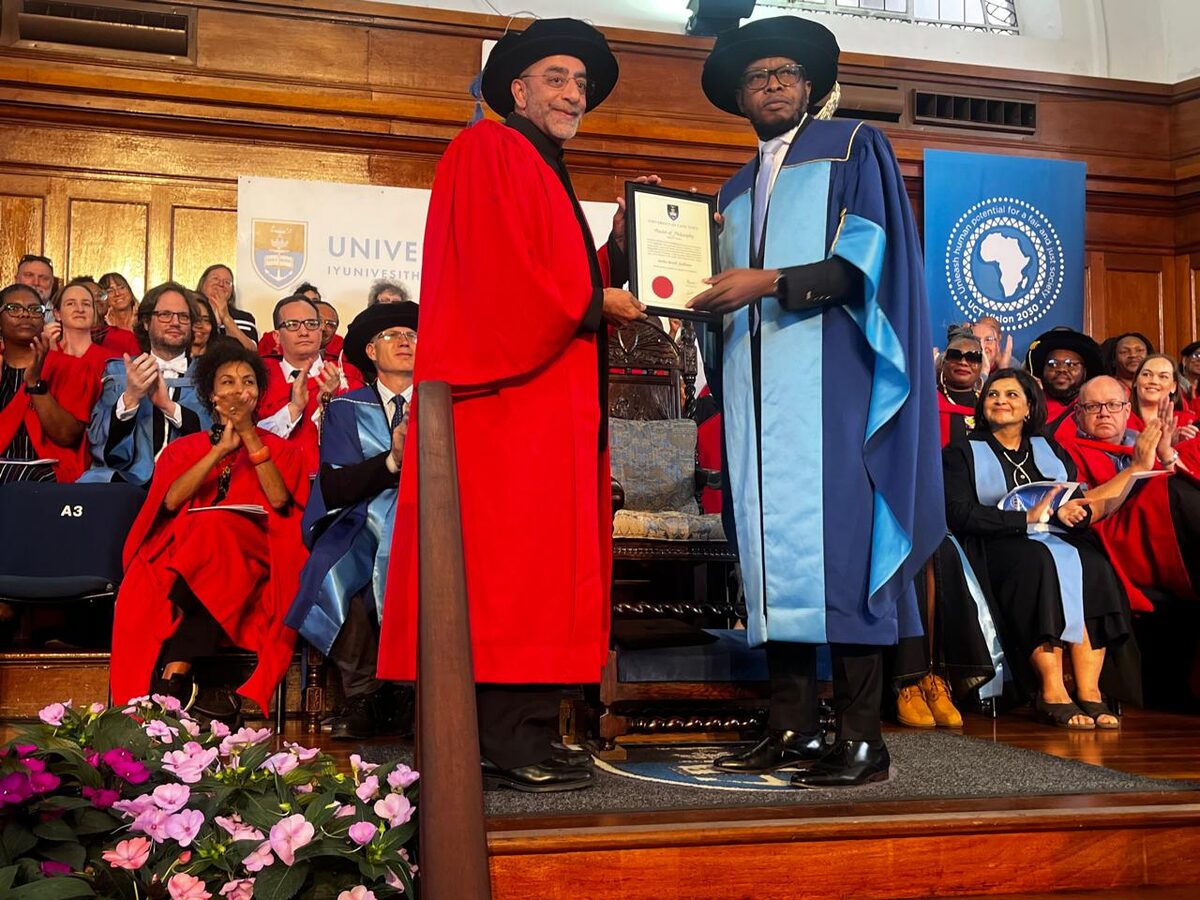
The University of Cape Town (UCT) has honoured Dr Imtiaz Sooliman with an honorary doctorate, recognising decades of humanitarian work across continents and crises.
But the founder of Gift of the Givers does not claim the honour as his own. He says it belongs to the people of South Africa.
Speaking to People’s Post, Sooliman described the recognition as a collective achievement rooted in faith, service and unity.
“My spiritual teacher made it very clear whatever is done is done through you and not by you,” he said. “I do not take credit for any of the accolades; Gift of the Givers is not a personal achievement.”
He said the doctorate symbolises the spirit of the nation.
“In essence, this doctorate celebrates 60 million South Africans. It acknowledges the greatness of South Africans.”
A calling shaped by instruction
Sooliman did not build Gift of the Givers from a business plan. He followed a calling.
“Gift of the Givers is not my idea,” he said. “I was instructed by a spiritual teacher: ‘My son, I am not asking you. I am instructing you to form an organisation.’”
That instruction came with a clear purpose: serve all people, regardless of race, religion or geography.
“Serve people with love, kindness, compassion and mercy,” he said. “Clothe the naked, feed the hungry, provide water to the thirsty and in everything you do, be the best at what you do.”
Today, Gift of the Givers stands as one of Africa’s largest disaster response organisations. Teams respond rapidly to floods, droughts and humanitarian crises across the world.
Sooliman credits that success to collective effort.
“It is supported by wives, children, families, strong teams, donors, public support, media and government,” he said. “It is a celebration of all South Africans.”
Hunger and healthcare top national concerns
While the doctorate celebrates achievement, Sooliman used the moment to highlight urgent national challenges.
“Hunger is the biggest problem in South Africa right now,” he said, warning that rising fuel and food costs will deepen the crisis.
He identified healthcare as the second major concern.
“There are not enough resources or medical personnel. The health system is in a huge crisis,” he said.
He pointed to surgery backlogs, equipment shortages and the need for urgent upgrades.
Water infrastructure, education and job creation remain critical.
“There are huge infrastructure problems, with no maintenance, no upgrades,” he said. “Many children do not know how to read or count. We need more teachers, more skilled teachers.”
On unemployment, he stressed the importance of dignity.
“We need to create many jobs to make independent people independent, not dependent on government grants.”
He also linked crime, corruption and mental health to the country’s broader struggles.
“Crime and corruption harm growth, harm development and create fear,” he said. “Many people are suffering mentally. We need more psychologists across the country.”
READ MORE: Fire sweeps through Maitland refugee camp leaving over 200 displaced
A call for active citizenship
Despite these challenges, Sooliman’s message remains hopeful.
“As South Africans, we should be patriotic,” he said. “The country does not belong to the government. It belongs to us.”
He urged citizens to take responsibility alongside government.
“No government in the world can manage alone. We as civilians must do what we can.”
He encouraged simple, everyday acts of service.
“Do not try to do anything big. Help your neighbour, your family member, a school child. Give advice, support, teach and encourage.”
He believes small contributions can drive large change.
“If 60 million South Africans each put in just one percent, we will make a huge difference.”
Faith and humanity at the centre
Faith remains central to Sooliman’s work, but he sees it as a unifying force.
“We need to go back to prayer, to faith, to God Almighty,” he said.
He called on religious and community leaders to guide society with compassion.
At the same time, he emphasised universal values beyond religion.
“Even without religion or spirituality, let us show goodness to each other,” he said.
His philosophy remains simple: treat others with dignity and care.
“What we would want somebody else to do for us in our difficulty, let us do that for someone else.”
A doctorate shared by a nation
For Sooliman, the UCT honorary doctorate reflects the collective spirit of South Africa.
“It is not for me,” he said. “It is for my family, my teams, my staff, the donors, the supporters and all of South Africa.”
In a country often defined by its challenges, his message reframes the narrative. Change does not rest with a few, but with everyone.
And in that shared responsibility, Sooliman sees the true meaning of service.