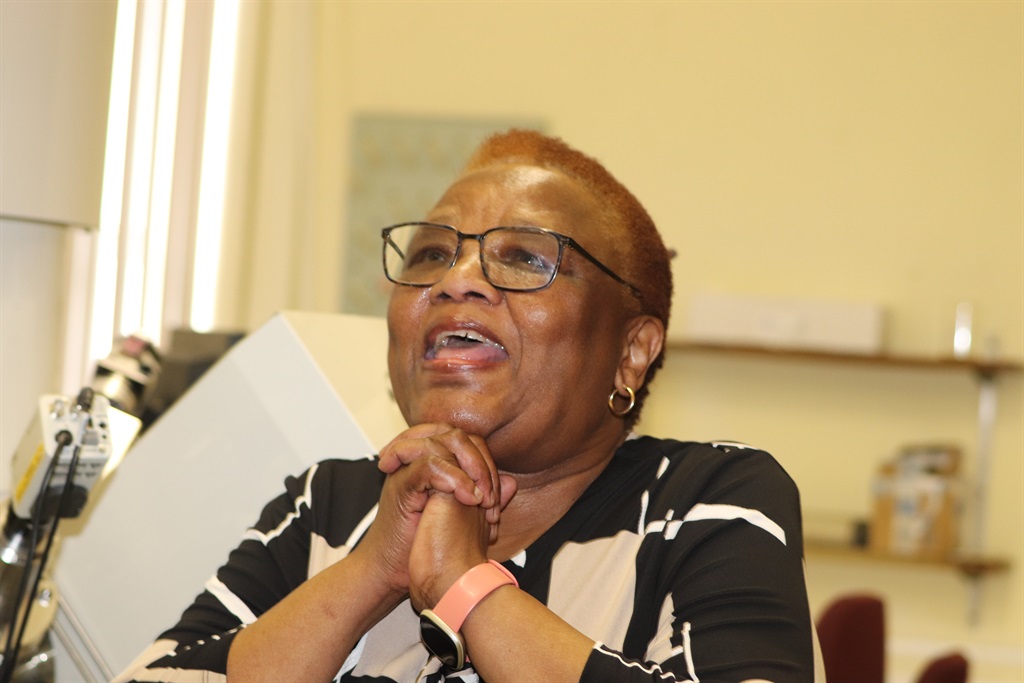
Rhodes University’s Director of the Institute for Nanotechnology
Innovation, Distinguished Professor Tebello Nyokong, has been selected as a
Fellow of the Royal Society.
Nyokong is one of the 80 outstanding
researchers, innovators and communicators from around the world who have been
elected as the newest Fellows of the Royal Society, the United Kingdom’s (UK)
national academy of Sciences and the oldest science academy in continuous
existence. The announcement was made yesterday, 10 May by the Royal Society.
The Royal Society is a self-governing
Fellowship of many of the world’s most distinguished scientists drawn from all
areas of science, engineering, and medicine. The Society’s fundamental purpose,
as it has been since its foundation in 1660, is to recognise, promote, and
support excellence in science and to encourage the development and use of
science for the benefit of humanity.
Nyokong and the 79 other elected researchers have been
selected for their substantial contribution to the advancement of science, from
the use of forensic techniques to identify victims of war crimes, to
investigating processes in the Earth’s core, and mapping the world’s largest
peatlands in the Congo basin.
The President of the Royal Society, Sir Adrian Smith said: “I am
delighted to welcome our newest cohort of Fellows. These individuals have
pushed forward the boundaries of their respective fields and had a beneficial
influence on the world beyond. Among this year’s intake are individuals who
were at the forefront of the response to the COVID-19 pandemic, and those
working on global challenges, from TB to climate change. They are pioneering
scientists and innovators from around the world who have confounded
expectations and transformed our thinking.”
Nyokong said she felt honoured by the election as she never
expected it. She said she shared the honour with her students, without whom she
would have never been a great scientist.
“In South Africa, we do not want to
offend anyone, but my work has always been about fighting the war against
stereotypes of colour and gender. I was not expected to succeed based on the
above. My success is due to my determination to train students who are truly
world leaders, who have integrity and who are humble. My main aim has been to
spread excellence among the African youth,” said Nyokong.
Thirty percent of this year’s
intake of Fellows, Foreign Members and Honorary Fellows are women. New Fellows
have been elected from 20 UK institutions, including Manchester, Sussex, Exeter
and Edinburgh. They have been elected from countries including Japan, Finland,
China and South Africa.
Rhodes University Vice-Chancellor,
Professor Sizwe Mabizela said he was hugely proud of Professor Nyokong.
“She is
a distinguished professor of our University. We are incredibly proud of her
contribution to the research output of the University and all her achievements.
She has very few equals in her area of speciality. She is making a huge
contribution to our country and to the whole world.
“As the University, we are
delighted to have academics of her caliber teaching our students, supervising
our postgraduate students and contributing to global knowledge,” he said.