

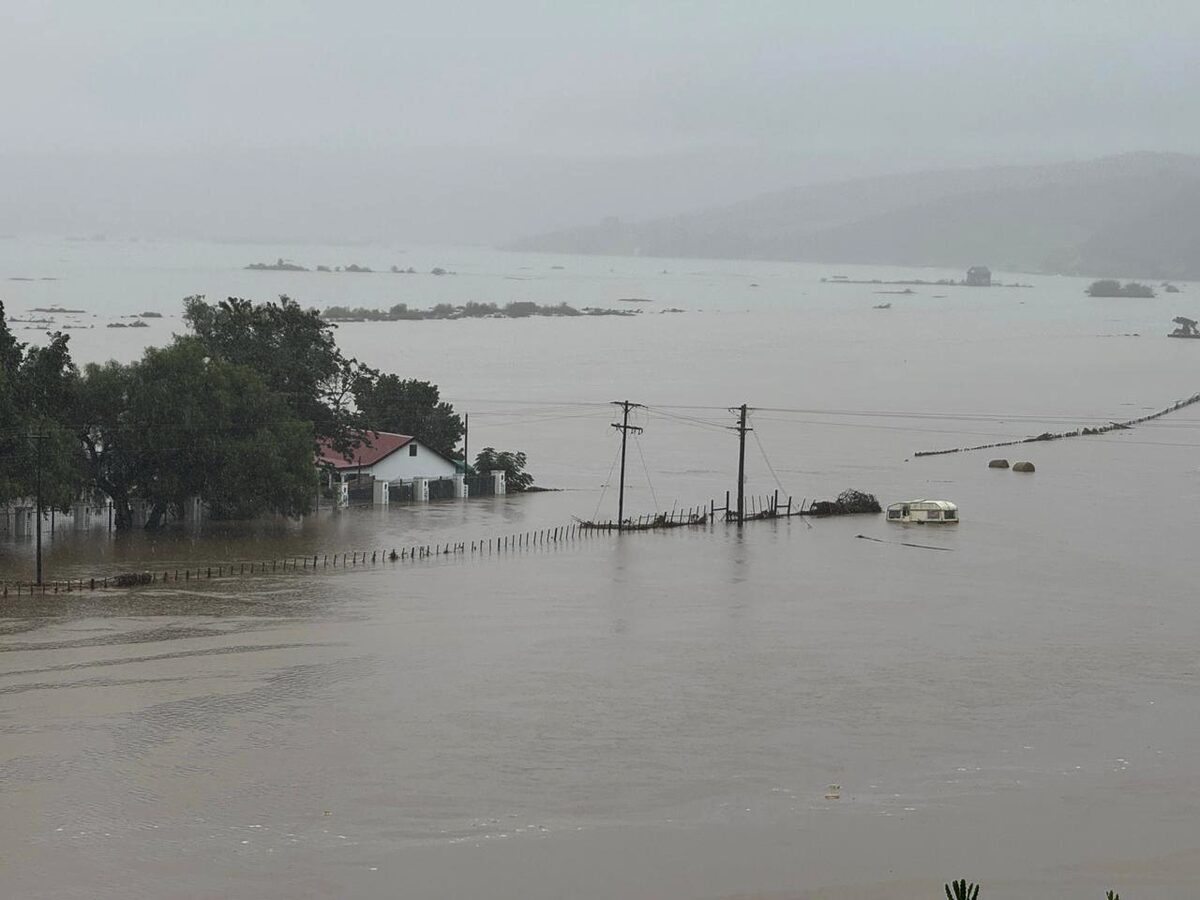
KOUGA – In what will be remembered as one of the most devastating natural disasters in the history of the Kouga region, floodwaters recently tore through towns, farms and rural communities.
One of the worst-hit areas was the Gamtoos Valley, with the Kouga Municipality issuing an urgent evacuation order for the area on 7 May after the Kouga Dam exceeded full capacity and began spilling.
The evacuation order followed the South African Weather Service’s Level 8 warning for disruptive rain in the Kouga and Kou-Kamma areas, which remained in effect from 5 May at 10:00 until 7 May at 23:59.
The well-loved Gamtoos Ferry Hotel was also flooded.
In a Facebook post on 11 May, the Kouga Municipality revealed that more than 300 residents were displaced as rivers burst their banks, roads collapsed, and homes became inaccessible.
“Families were evacuated to safety and are currently being accommodated at various community halls and farms across the region, where they continue to receive support, meals and care from local authorities, businesses, farmers, volunteers and residents,” the municipality said.
“Among the rescues was the evacuation of 49 people at Kingsway, where rising waters threatened homes and trapped residents. In other areas, several residents remain isolated due to severe flooding and extensive road damage. Thankfully, they are safe and have sufficient food supplies while teams continue to monitor the situation closely.”
Despite the scale of the disaster, the municipality indicated that no lives were lost.
The municipality urged residents to remain vigilant, avoid unnecessary travel and never attempt to cross flooded roads or bridges.
“Kouga Local Municipality teams have been working around the clock, leading extensive mop-up operations, assessing damage and restoring critical services under extremely difficult conditions,” the municipality said.
“Roads throughout the region have taken a severe beating, with potholes and wash-aways posing significant risks to motorists.”
The municipality indicated that several roads remained closed or inaccessible.
The municipality said electricity teams had worked tirelessly, often through the night and in dangerous weather conditions, to restore power to affected communities.
“While many areas have already been reconnected, some communities supplied through the Eskom network remain without electricity due to inaccessible terrain and extensive infrastructure damage,” the municipality said.
“Despite these challenges, Eskom teams continue to work relentlessly to restore supply as quickly as possible. Some areas are also experiencing connectivity problems.”
Residents were encouraged to assist by reporting damaged electrical infrastructure and sending pin locations to the Kouga Call Centre at 042 200 2200 or via WhatsApp at 081 760 9183.
The municipality indicated that this information would help Eskom and municipal teams locate faults faster and respond more effectively.
The municipality also highlighted the overwhelming compassion shown by the people of Kouga.
“Businesses, farmers, organisations and ordinary residents have opened their hearts and stepped forward with donations of food, blankets, clothing, animal feed, accommodation and support for displaced families. Volunteers have worked tirelessly behind the scenes, while emergency teams, municipal workers and rescue personnel have placed themselves in harm’s way to protect others,” the municipality said.
According to a Gamtoos Valley resident, Colin McDonald, residents living along the Gamtoos Lagoon were largely spared from the worst of the recent flooding that devastated parts of the Gamtoos Valley.
He said everything was fine where he was located, explaining that his home is situated along the Gamtoos Lagoon, which lies much higher than the Gamtoos River.
McDonald further said that while his area escaped major damage, communities located closer to the river, including Big Fish and Kingsway, were forced to evacuate due to the floodwaters.
“Sadly, towns along the river had to evacuate due to the flooding,” said McDonald.
He said the broader community quickly came together to support affected residents by donating essential items to those who had been evacuated and needed assistance.
McDonald added that he had experienced at least three flood events during his lifetime while living in Gqeberha before relocating to the Gamtoos Valley.
As a result of those experiences, he deliberately chose to build his home along the lagoon, where he believed the flood risk would be lower.
Although floodwaters from the lagoon reached his property and rose to about a metre high, McDonald said neither he nor his neighbours suffered major damage.
“Thankfully, my neighbours and I were not significantly affected by the recent flood,” said McDonald.
He said many farmers in the Gamtoos Valley were not as fortunate, with several losing significant amounts of produce and equipment during the disaster.
McDonald said that he and other residents were currently assisting one of the affected farmers to recover equipment that had floated onto the beach during the flooding.
Despite the temporary closure of the R102, McDonald said it did not significantly affect residents in his area because they did not need access to the road at the time.
Eunice Boesman said her home in Thornhill remained flooded and that she was currently staying at a shelter after heavy rains caused extensive damage.
“My own house inside is flooded. Things are bad,” said Boesman.
She said water entered her home and left many of her belongings soaked.
“My room is full of water, and my clothes are all wet,” said Boesman.
She explained that conditions inside the home remained difficult, with her blankets and other belongings still wet days after the flooding.
Boesman was caring for her seven-month-old grandchild while trying to recover from the disaster.
She also said that she suffers from arthritis and asthma, making the conditions particularly challenging.
Boesman said she was unable to remain at the community hall, which had been designated as temporary accommodation for flood victims, because sleeping on the floor worsened her health conditions.
She said the municipality’s disaster management team assisted residents whose homes had flooded and transported them to the community hall for shelter.
Despite the hardships, Boesman said she remained hopeful.
“I believe that God will make a way for me during this difficult time,” said Boesman.
Community organisations have also stepped in to assist with cleanup efforts following the severe weather and flooding experienced across the Kouga region.
According to Loulita Vosloo, volunteers from Jeffreys Bay Dorp van Drome, a local organisation dedicated to cleaning and beautifying the town, began clearing roads as soon as weather conditions improved.
She said they had been picking up stones and branches in the road.
Vosloo said volunteers continued cleanup operations on 11 May by removing palm trees that had fallen into roads and loading them onto bakkies.
“We are basically just assisting and helping the municipality to clean up as quickly as possible, weather permitting,” said Vosloo.
She explained that strong winds continued to pose a risk, with loose branches and debris potentially causing damage to vehicles.
“If the strong winds come, these branches just keep falling off, and I think they could actually result in some of the cars being damaged if a car passes and the wind carries one of these branches that are already lying on the ground,” said Vosloo.
She added that several trees had also fallen within their own areas, but removing them had proved difficult without access to heavy-duty municipal vehicles.
Vosloo said the organisation hoped some of the fallen trees could still be repurposed once conditions had stabilised.
“Where the stems are thick enough, we would like the municipality to salvage them and set them aside so that we can cut them into 15-centimetre slices to use as paving,” said Vosloo.
ALSO READ: CapeNature reserves hit by flooding and infrastructure damage