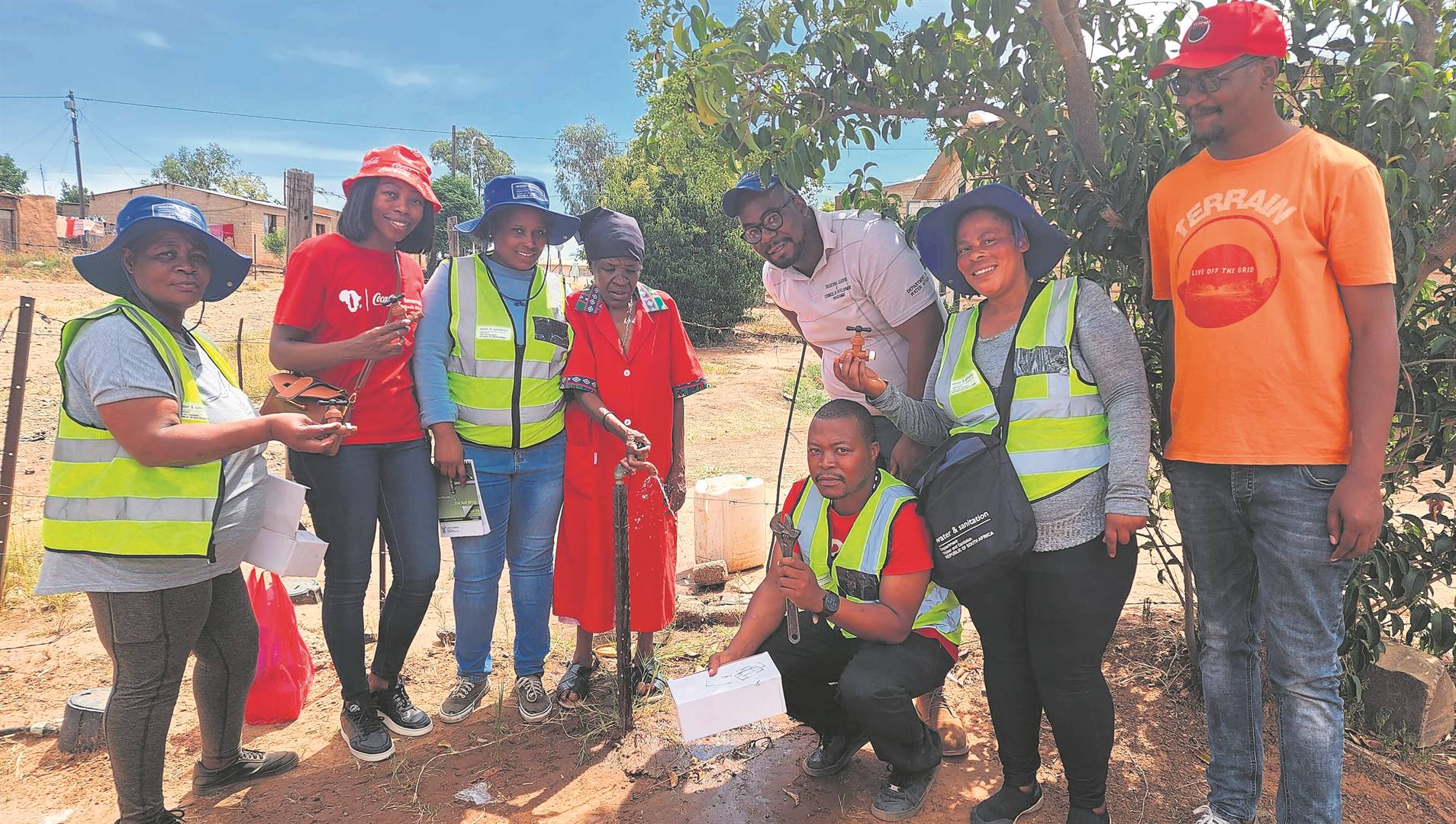

The Department of Water and Sanitation (DWS) encourages residents in the Free State to continue preserving water and use it wisely.
This followed the significant decrease of water levels in storage dams.
The department’s weekly hydrological report showed that water levels are hovering below 82,0% compared to last year’s 96,8% at this time, attributing the drop to among others poor rainfall during the winter season.
Other factors include the inability of municipalities to fix broken pipes and leakages timeously, resulting in the loss of billions of litres of water and revenue collection. Evidence thereof is research done by the Water Research Commission (WRC), revealing that almost 45% of the total municipal water supplied in South Africa is lost before it reaches municipal customers, from industry to households, owing to the inability to maintain and fix water infrastructure.
The dams which had water levels decrease to below the 70,0% mark, are Fika-Patso (56,3%) supplying the greater Qwaqwa area, Allemanskraal (58,0%), Groothoek (65,2%) and the Vaal Dam (48,1%). The Metsi Matsho Dam, also supplying Qwaqwa, is hovering at 79,0%.
According to the department, the supply capacity of most district municipalities have also been impacted following a sharp decline in storage dam water levels.
The Bloemfontein water supply system which consists of the dams Welbedacht, Knellpoort, Krugersdrift, Mockes and Rustfontein, supplying the Mangaung Metro and surrounds, is sitting at 85,4% after dropping from 85,7%. Last year the system was hovering at 96,7%, at this time.
The Thabo Mofutsanyane district’s capacity water levels remained unchanged at 97,8%, despite a sharp drop of water levels at the Fika-Patso and Metsi-Matsho dams.
The Xhariep district’s capacity is at 85,4%, while last year it stood at 97,4% at this time. The Fezile Dabi district, water capacity is at 71,1%, while last year it stood at 96,1%.
The Lejweleputswa district water levels stood at 87,6%, while this time last year it was at 101,6%.
Three major dams, namely Gariep, Krugersdrift, and Vanderkloof, serving as backup storage in the province have also seen a decline in their levels compared to the previous year. However, Krugersdrift and Vanderkloof are still holding their fort, sitting at 92,5% and 98,8%, respectively.
Last year they stood at 100,4% and 99,6%, respectively. The level of water at the Gariep Dam has dropped sharply to 77,0%, compared to last year when it stood at 95,9%.
The Saulspoort Dam in Bethlehem is bustling with water, currently sitting at 102,8%, above last year’s mark of 98,8%.
Overall, the provincial water storage level appears to be in healthy state, sitting at 81,6% while in the same term last year it stood at 96,8%.
Free State municipalities are among those flagged for operating as concern grows for their failures to maintain water infrastructure, and service water accounts to supplying entities such as the Vaal Central Water (VCW) board (formerly BloemWater). Their debts have continued escalating, owing to a failure to pay despite several service level agreements, including an intergovernmental agreement (IGA) entered. Non-payment often leads to the supplier reducing its supply to 30%.
Above-mentioned applies to two municipalities, Matjhabeng and Nala. The Matjabeng Municipality reportedly owes the VCW more than R6,7 billion, while Nala’s debt amounts to more that R390 million.