Young people are helping researchers rethink how violence and safety are understood — and what should be done about it.
The youth from Mitchells Plain have joined an international research project that places them at the centre of finding solutions to urban violence. The project, led by the London School of Economics and Political Science (LSE) and funded by the Swedish International Centre for Local Democracy (ICLD), is running in two cities simultaneously: Cape Town and Medellín, Colombia’s second-largest city.
Both cities have long histories of violence and insecurity, but also of communities that have pushed back, survived, and searched for a way forward.
Ashton Botha, the local facilitator based at the University of Cape Town, said the aim was always co-creation, not extraction.
“It’s really about building something in Mitchells Plain,” she said. “It’s not just about us extracting information or their time.”
More than just about crime
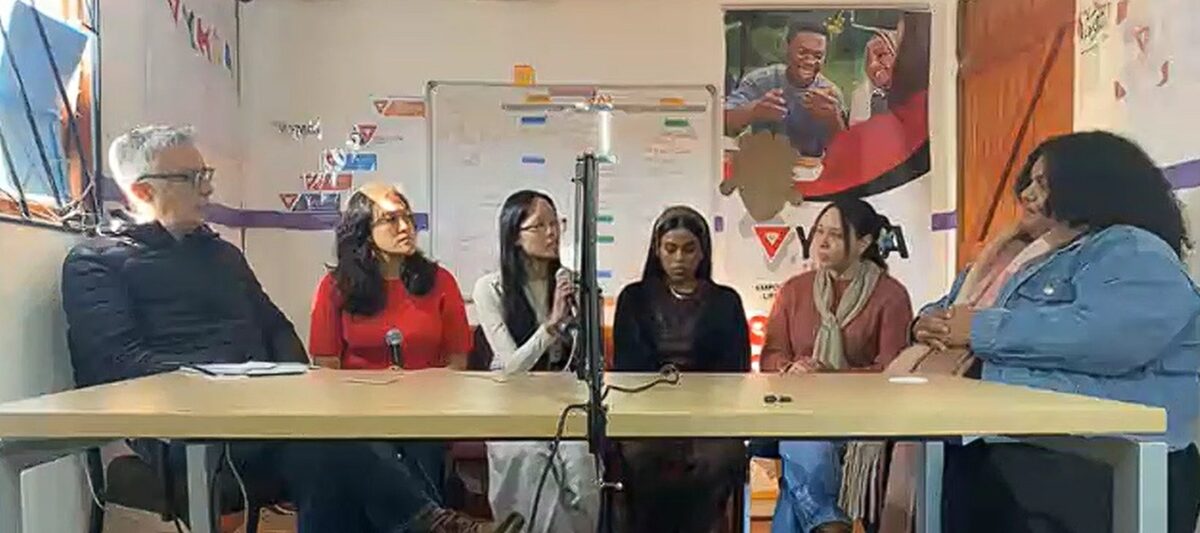
For the young people involved, safety means far more than not being robbed or shot. Speaking during a live podcast on Saturday 6 June, for Youth Month and Child Protection Week, the participants shared what security means to them.
Nazreen Ryklief, a psychology student who moved to Mitchells Plain during her second year at university, said the shift from the northern suburbs changed everything.
“I feel unsafe even just driving up to university,” she said. “I still remember talks in the evenings with my grandmother and my family members around being careful when leaving at a certain time, making sure your doors are locked at night.”
She added that security, to her, is not just about the neighbourhood.
“Security means being able to see whether I do have a future, where I see myself five years from now, and being able to afford or be granted certain opportunities outside of my community.”
Zayaan Petersen echoed the point, saying safety also means being comfortable enough to walk to the tuck shop or the bus stop alone.
“You don’t feel safe anymore walking by yourself, especially as a female,” she said.
Zohrah Curnow described safety as both physical and emotional — having the right people around you and the values that keep you grounded.
What the research found
Alexandra Abello Colak, an LSE researcher originally from Colombia, said these experiences matched almost exactly what young people in Medellín had shared.
“Everybody experiences insecurity and security differently, depending on their age, depending on their gender, depending on where they live,” she said. “Normally when we hear politicians or even experts in security talking about security, they speak about security as if we are all in the same situation.”
She said the research had shown that improving security requires more than policing.
“It’s not just about crime, it’s not just about the police — you need a lot of things in order to guarantee the type of security that talks about emotional and health safety, or being able to feel that you have opportunities for the future.”
Gareth Jones, a professor at LSE and one of the lead researchers on the project, agreed. He noted that once young people’s experiences reach policymakers, something is often lost.
“You become a statistic. You become an object of the policy rather than the subject of how that policy is being thought about.”
Young people co-produce the research
The project, which has been running since July 2025, takes a participatory approach — meaning the young people are not just research subjects but active contributors. They helped design a community survey, making sure the questions were worded in a way that other young people could actually understand.
“Instead of just generating a standard survey to send out to the youth, we were able to engage and structure the survey in such a way that the youth can actually understand what you’re asking,” said one participant.
A similar process took place in Medellín, where the young people involved reportedly said their co-produced survey was better than the one the government had rolled out at the same time — and refused to complete the government version.
The survey in Mitchells Plain revealed that the top three challenges young people face are unemployment, poverty and food insecurity, and gangsterism.
A podcast with a purpose
One of the most talked-about outcomes of the project is a podcast, also called Voices of the Plain. The idea came from one of the young participants, who had read about a podcast programme started in another community and saw how much of an impact it had.
“I didn’t actually realise that you can actually be more involved and that people do actually listen to the youth,” she said, “instead of just coming towards them, asking for their experiences just to write a simple research paper and moving on.”
The podcast, which can be followed on Instagram and YouTube under the name Voices of the Plain, gives the young people from different parts of Mitchells Plain a platform to speak for themselves and for their communities.
Looking ahead
The young participants were clear about what they want to see in the future: more opportunities, more community initiatives, and less top-down decision-making.
“My wish for the future is to see young people leading,” said one participant. “Young people are equipped — it’s just that we don’t get the proper mentoring.”
Another called for practical community programmes that address the school dropout rate and unemployment — not just grants that tell young people to become entrepreneurs.
“Instead of bringing that solution and saying we can’t provide you any other opportunity, you need to make the opportunity yourself — I feel that bringing more opportunity in, and asking the youth specifically about what type of opportunities they want to see in the community, would make a difference,” she said.
The project still has more to come. A mural is being painted in Beacon Valley by young people from that area, focused on legacy. The podcast will continue after the project formally ends, and stakeholder meetings — where the young people will be present — are planned to take the research findings into policy conversations.
About the project
The research is titled Addressing Urban Violence through Participatory Research with Youth in Colombia and South Africa. It is led by Gareth Jones and Alexandra Abello Colak of LSE, with local research coordination by Ashton Botha and community facilitation by Rivonne Valentine in Cape Town, and by Universidad de Antioquia in Medellín. It is funded by the Swedish International Centre for Local Democracy (ICLD).
ALSO READ: Safe zone activities get underway across Mitchells Plain as R9m plan rolls out